
A busy marketing team can launch campaigns, fill dashboards and still struggle to explain what’s driving revenue. Marketing operations consulting should close that gap by connecting diagnosis, implementation and commercial accountability.
If your systems don’t share reliable data, manual workflows slow execution, or recommendations stall without an owner, the issue may not be a lack of activity. It may be a lack of infrastructure that turns strategy into repeatable performance.
This guide explains what marketing operations consulting should deliver, how to assess whether an engagement fits your business, and how to move from fragmented processes to scalable execution. You’ll learn how to identify operational constraints and their commercial impact, align technology, workflows and measurement with B2B go-to-market priorities, and assign clear responsibilities for implementation and progress. We’ll also explore how marketing automation, AI agents and fractional CMO leadership can support your operating model. The goal is a practical path from insight to action, with accountability built in.
Key Takeaways
- See how marketing operations connects people, processes, platforms and data to make B2B execution measurable.
- Trace the journey from campaign planning to sales hand-off to pinpoint where process, ownership or technology gaps disrupt performance.
- Compare consulting, agency, internal and fractional models by the work they own and the capabilities your team needs.
- Scope an engagement around a defined business problem, baseline measures, clear priorities and accountable owners.
- Explore how Monkeybox Media aligns marketing operations, automation and fractional CMO leadership with B2B go-to-market priorities.
What marketing operations consulting covers, and why B2B teams need it
Marketing operations consulting examines how people, processes, platforms and data work together to deliver and measure marketing performance. The aim is to make the operating system behind marketing more reliable, so teams can execute priorities, understand results and improve how work moves from planning to revenue contribution.
That’s different from running campaigns, licensing software or setting broad marketing direction. Campaign execution delivers specific activity. Software provides tools. Strategic marketing defines where and how to compete. Operations connects those decisions to the workflows, system configuration, data standards and measurement practices that make execution repeatable. It turns plans into a functioning delivery model.
Friction becomes harder to ignore as a B2B organisation adds people, channels, markets or technology. A lead may pass through several teams and platforms before sales acts on it. If each hand-off uses different definitions or depends on manual updates, delays and data gaps compound. A dashboard can look complete while failing to show which activity influenced pipeline or where prospects stalled.
Reliable marketing operations help teams execute consistently, measure performance with confidence and identify where the process needs to improve. That connection matters commercially: leaders need to know whether operational constraints are slowing follow-up, obscuring campaign contribution or consuming capacity that could support growth.
What does a marketing operations consultant do?
A consultant starts by diagnosing how work actually happens, rather than recommending a new platform on sight. They map processes, clarify ownership, assess data quality and examine whether existing technology supports the team’s goals. The diagnosis should identify root causes, such as duplicate data entry, unclear lead criteria or reports built on inconsistent definitions. Recommendations then need a practical implementation path, with priorities, accountable owners and measures for tracking progress.
When does a B2B business need outside support?
Look for repeated manual hand-offs, reporting that changes depending on who prepares it, campaigns delayed by workflow bottlenecks, or teams maintaining separate versions of the same data. These are signals to investigate, not problems to automate away. Trace each symptom to its process, ownership, data or system cause before choosing a fix.
Outside support can suit a defined project, such as resolving a reporting gap or improving a workflow. A recurring capability or leadership gap may call for sustained operational support, or fractional CMO direction that connects systems and execution to wider go-to-market priorities. Choose the form of support based on how long the problem is likely to persist and who needs to own it. A one-off diagnosis won’t solve a persistent issue if nobody has the responsibility or capacity to implement and maintain the changes.
Effective marketing operations consulting closes the gap between identifying a constraint and changing how the business operates. Its value isn’t measured by the number of recommendations produced, but by whether teams can put them into practice and see the effect in day-to-day execution.
How marketing operations consulting diagnoses the engine behind execution
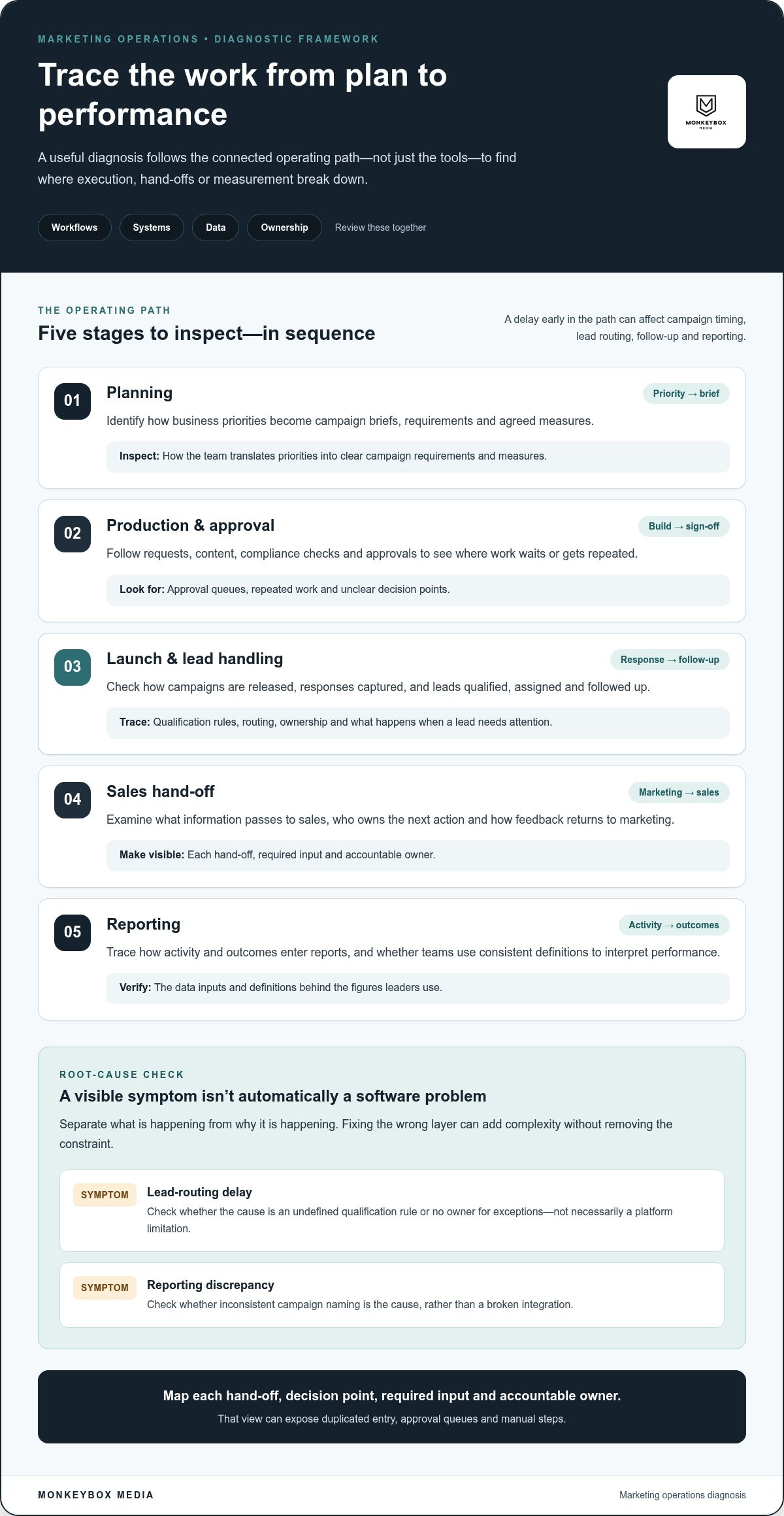
A useful diagnosis follows work from the moment a business priority becomes a marketing plan through campaign delivery, lead handling, sales hand-off and performance reporting. Marketing operations consulting should examine these stages as one connected system. A delay near the start can affect campaign timing; unclear lead criteria can then disrupt routing, follow-up and the figures leaders rely on to assess results.
An operational diagnosis reviews workflows, systems, data and ownership together, showing how they shape execution and measurement. That view prevents teams from treating every visible problem as a software problem.
A structured review can trace the operating path in sequence:
- Planning: Identify how business priorities become campaign briefs, requirements and agreed measures.
- Production and approval: Follow requests, content, compliance checks and sign-off to see where work waits or gets repeated.
- Launch and lead handling: Check how campaigns are released, responses captured, and leads qualified, assigned and followed up.
- Sales hand-off: Examine what information passes to sales, who owns the next action and how feedback returns to marketing.
- Reporting: Trace how activity and outcomes enter reports, and whether teams use consistent definitions to interpret performance.
At each stage, separate the symptom from its cause. A lead-routing delay might appear to call for a platform change, but the underlying issue could be an undefined qualification rule or no owner for exceptions. A reporting discrepancy may stem from inconsistent campaign naming, not a broken integration. Fixing the wrong layer adds complexity without removing the constraint.
Where workflows and hand-offs create operational drag
Map how work moves between the people who request, approve, build and launch campaigns, then follow what happens when a response arrives. Record each hand-off, decision point, required input and accountable owner. This exposes duplicated entry, approval queues and manual steps. Not every manual task should be automated. First establish whether it adds control or simply compensates for a poorly designed process. A documented workflow makes the difference visible.
How systems and data shape reliable measurement
Next, assess whether the CRM, marketing automation and reporting setup reflects the agreed workflow. A system can pass information successfully and still produce misleading reports if teams define a qualified lead differently or leave key fields incomplete. Integration answers whether records move between platforms. Measurement design answers which outcomes matter, how they’re defined and who acts on them. Both must align.
For example, compare the status recorded at marketing hand-off with the sales team’s follow-up outcome. If those stages use different criteria, leaders can’t reliably identify whether the issue sits in lead quality, routing or follow-up. Document definitions and ownership before changing technology. That sequence keeps the diagnosis focused on causes and gives implementation a clear target. For B2B teams connecting operational systems to broader growth priorities, marketing operations support can help turn the review into practical action.
Consultant, agency, or fractional operator: which model fits the work?
The right delivery model depends on the gap you need to close, the work that must happen and who will own it afterwards. A specialist consultant may define the fix, an agency may bring delivery capacity, an internal hire can build lasting in-house capability, and a fractional leader can connect operational priorities with senior marketing direction. These models can overlap, but their responsibilities should be explicit.
Use this comparison to focus on scope and ownership, not labels alone. Individual arrangements vary, so define the work and decision rights before choosing a structure.
| Model | Strategic direction | Implementation responsibility | Continuity | Internal capability needs |
|---|---|---|---|---|
| Independent consultant | Usually focused on a defined operational problem | Advisory by default; hands-on delivery can be scoped | Often tied to the engagement | Internal owner needed to make and maintain changes |
| Agency support | May connect delivery to a wider marketing plan | Can provide a team for agreed execution work | Depends on the ongoing arrangement | Needs a client-side decision-maker and access to relevant teams |
| Internal hire | Shaped by the role and its authority | Owned within the organisation | Builds knowledge in-house over time | Requires capacity to recruit, onboard and support the role |
| Fractional leadership | Provides ongoing senior direction and prioritisation | Can guide implementation; delivery ownership must be agreed | Provides continuity across strategic decisions | Requires internal partners to carry out and embed decisions |
A consulting engagement can become a slide deck if nobody owns implementation. Before work begins, make clear who approves recommendations, changes processes and systems, communicates new workflows, and tracks progress. If the consultant is advisory, name the internal lead responsible for delivery. If hands-on implementation is required, specify which tasks the external team owns and where client decisions or input are needed.
What changes between advice, implementation, and ongoing leadership?
Advisory work diagnoses constraints and sets out recommendations, while the client leads implementation. Implementation support adds practical delivery, such as putting agreed processes or system changes into practice. Fractional leadership adds ongoing senior marketing direction, setting priorities and aligning operational decisions with business goals. Each model can be useful; distinguish advice, delivery and decision-making in the scope.
How to match the engagement model to the operating gap
How to scope a marketing operations consulting engagement
A strong scope turns an operational concern into a defined piece of work with clear boundaries, owners and evidence of progress. Before selecting a tool or redesigning a workflow, agree on the business problem and how you’ll know whether the response is working. This keeps the engagement focused on outcomes rather than a list of activities.
Use this sequence to build the scope:
- Define the business problem. State the constraint in practical terms, such as delayed campaign launches, slow lead routing or reporting that can’t support decisions. Identify the commercial or execution impact the work should address.
- Map the current state. Document the affected workflows, teams, systems and decision points. Establish how the process operates now, including exceptions and manual workarounds, rather than relying on assumptions about how it should work.
- Agree priorities. Rank issues by business relevance, dependencies and feasibility. Specify the first changes to tackle and what will wait, so new findings don’t silently expand the engagement.
- Assign ownership. Name who approves decisions, leads implementation, provides team or system input, and maintains changes after delivery. Make external and internal responsibilities visible.
- Review progress. Set review points to assess evidence, resolve dependencies and adjust priorities when findings warrant it. Keep decisions and next actions documented.
Set a baseline before making changes. Depending on the constraint, useful starting measures might include the time from campaign request to launch, time from lead capture to assignment, the proportion of records with required fields completed, or conversion between defined funnel stages. Record how each measure is calculated, its data source and the period it represents. Without that reference point, a later change in the numbers may be difficult to interpret.
Define the problem, boundaries, and ownership
Write the brief around the affected process, teams, systems and decision-makers. State what’s in scope, such as improving a particular hand-off, and what’s out of scope, such as replacing unrelated platforms. Record who owns implementation decisions and who supplies operational input. Review points should surface dependencies early and allow priorities to change when evidence reveals a different constraint.
Measure progress without mistaking activity for impact
Choose a small set of indicators linked to the diagnosed issue. Email volume or campaigns launched can show activity; routing time, workflow completion or stage conversion can indicate execution reliability and performance. Track adoption of the new process alongside relevant business signals, but don’t claim revenue was caused by the engagement when other factors may have contributed. Useful measures depend on the agreed business objective and the baseline established before changes begin.
A well-scoped marketing operations consulting engagement makes responsibility and progress visible from the outset. Work with Monkeybox Media to define your engagement scope, including the problem, boundaries and measures for your B2B operation.
How Monkeybox Media connects marketing operations with B2B growth
Marketing operations create value when they support the way a B2B organisation plans, reaches and serves its market. Monkeybox Media brings together marketing operations, automation implementation and go-to-market strategy to connect operational infrastructure with commercial priorities. The focus is not on adding tools for their own sake, but on building a practical operating model that helps teams execute their strategy.
That link matters when a go-to-market plan depends on coordinated activity across marketing and sales. If workflows, data and technology don’t support the plan, execution can become inconsistent and performance harder to interpret. Monkeybox Media’s marketing operations consulting connects these elements with implementation, rather than leaving recommendations as disconnected strategic documents.
Fractional CMO leadership adds senior marketing direction when operational decisions need to align with wider priorities. It helps frame the questions that guide the work: which audiences and routes to market matter, what the team needs to execute, and which operational constraints deserve attention first. For a closer look at this leadership model, explore the fractional CMO agency guide.
Connect operational infrastructure to go-to-market priorities
A coherent B2B go-to-market plan needs more than a strategy document. Its processes, systems and measurement should support how the organisation attracts and handles demand, coordinates marketing and sales, and assesses progress. Campaign planning, lead management and reporting need shared definitions and clear ownership if teams are to act on the same priorities. Monkeybox Media connects these operating components with go-to-market strategy, helping keep execution aligned as plans move into day-to-day work. The result is a stronger foundation for repeatable activity, not another disconnected tool or roadmap.
Turn automation and AI into practical operating capability
Automation should follow process diagnosis and clear operational requirements. Automating an unclear workflow can make confusion move faster, so first establish the steps, decision rules, ownership and desired outcome. Then assess where marketing automation can reduce repetitive work or support reliable hand-offs. AI agents can also serve as workflow components in suitable marketing processes, with people retaining oversight, decision-making responsibility and accountability. They’re not a guaranteed replacement for teams. They need a defined role within an operating model that people understand and can manage.
Monkeybox Media’s B2B marketing operations work connects these decisions with implementation and strategic direction. Discuss your marketing operations constraint and intended outcome with Monkeybox Media, starting with the issue you need to resolve and the progress you want to make.
Make your next operational move count
Choose one constraint that’s holding back execution and make it the starting point for change. Define what needs to work differently, who must be involved and what evidence would show progress. A focused first move gives your team a practical way to build momentum without turning improvement into another open-ended initiative.
The value of marketing operations consulting comes from making the operating model work harder for your business priorities. That takes clear decisions, committed ownership and a willingness to adjust when implementation reveals what the team needs next. Progress is built step by step.
Monkeybox Media works with B2B organisations to connect marketing operations priorities with the direction of the business. Plan your next marketing operations step with Monkeybox Media and turn the constraint in front of you into a clear starting point for action.
Frequently Asked Questions
What is marketing operations consulting?
Marketing operations consulting helps a business strengthen the capabilities that support marketing delivery and decision-making. For example, a team may need shared campaign naming rules so activity can be compared consistently across channels, or clearer data ownership so records stay useful over time. The engagement should connect recommendations to a real operating need and specify who will put changes into practice, rather than treating new technology as the end goal.
When should a B2B company hire a marketing operations consultant?
A B2B company should consider outside support when operational problems keep disrupting delivery and the team can’t resolve them with its current capacity or expertise. A practical trigger might be repeated launch slippage despite a stable campaign plan, or sales and marketing disagreeing about which leads need follow-up. Record where the delay occurs, who is affected and what decisions are blocked. That evidence helps define whether specialist support can address the gap.
Is marketing operations consulting different from marketing automation?
Yes. Marketing automation uses technology to carry out tasks such as sending a nurture sequence after a defined trigger. Marketing operations consulting examines whether that workflow fits the wider process, whether its data inputs are dependable, and who reviews exceptions. If a nurture programme sends unsuitable messages because audience criteria are unclear, adding automation won’t resolve the underlying issue. Consulting helps establish the operating requirements before automation is configured or changed.
How do you measure the success of marketing operations consulting?
Measure success against the specific constraint the engagement set out to address. If campaign approvals cause delays, compare approval turnaround before and after the process change; if lead records are incomplete, track the agreed required fields. Also check whether teams are using the new workflow, since implementation without adoption won’t change daily operations. Keep these indicators distinct from wider pipeline results, which may reflect several influences beyond the engagement.
Should a company choose a consultant, an agency, or fractional support?
Choose according to the capability and ownership the work requires. A consultant may suit a contained question when your team can act on the findings; an agency arrangement can support coordinated delivery across multiple activities; fractional leadership can provide continuing senior direction where marketing priorities need clearer alignment. For example, a team with delivery capacity but no agreed priorities may need leadership, while a defined workflow issue may need focused operational expertise.
How much does marketing operations consulting cost?
There isn’t one standard fee because the work can range from a focused diagnostic to implementation across several systems and teams. Scope, complexity, duration and the division of responsibilities all affect what an engagement involves. Compare proposals by the work and accountability they include, not just the headline figure. Clarify deliverables, decision-makers, client-side input and how progress will be reviewed before assessing whether the proposed scope fits your business need.
Can AI agents be used in marketing operations?
Yes, AI agents can be used in suitable marketing workflows when their task and boundaries are clearly defined. A team might assess whether an agent can support a repeatable research or content-operations step, while a person remains responsible for reviewing outputs and handling exceptions. Start with a workflow that has clear inputs and an observable result. If the process or source data is unreliable, address that first rather than expecting an agent to resolve it.