
Software marketing works when it connects a defined audience with a distinctive business outcome, then measures how each channel helps buyers make a decision. A marketing strategy for technology companies should combine buyer research, useful content, lead nurturing and performance measurement. Paid campaigns can generate responses sooner, while SEO and social media take consistent effort to build visibility.
It’s easy to focus on activity: more posts, campaigns and leads. But activity alone won’t show whether marketing is contributing to growth. Give marketing a strategic role instead, with clear priorities and metrics that link campaigns to commercial outcomes.
This guide explains how to research technology buyers, choose relevant channels, sharpen your value proposition and nurture leads with useful, timely communication. It also covers what to measure and why results arrive at different speeds, helping you build a focused programme and make decisions based on performance, not volume.
Key Takeaways
- Set expectations by channel: paid campaigns can show results sooner, while SEO and social media build visibility through consistent effort.
- Map the buyers, users, influencers and senior decision-makers involved, then choose channels around their needs and intent.
- Translate product features into business outcomes so buyers can see what makes your offer distinct.
- Use relevant, personalised follow-up to nurture leads and keep them moving through the buying process.
- Measure activity against business goals, using performance data to decide what to refine, scale or stop.
1. How long does it take to see results with your digital marketing strategy?
There’s no single timetable for digital marketing results. Paid advertising can generate responses sooner, while SEO and social media need sustained activity to build visibility. Content marketing can compound over time: an article answering a software buyer’s technical question may attract relevant readers well after publication. Measure early engagement separately from pipeline and revenue, which depend on buyer readiness and the length of your sales process.
Set content goals against business outcomes before choosing formats. If qualified pipeline is the priority, track whether content attracts target accounts and supports sales conversations. If retention is the focus, improve product documentation so customers can solve problems and get more value from the software. Start by defining the audience, choosing the outcome, selecting a metric, then reviewing performance regularly. Thought leadership should demonstrate expertise through useful explanations, not product claims alone.
Buyers consume an average of 13 pieces of content before making a purchasing decision. That gives technology companies a reason to build a connected library: a technical guide, a customer example, a product explainer and follow-up content can address different questions along the journey. Short-form content also has a role, with 65% of B2B buyers finding it appealing. Repurpose a research finding into a concise post, then direct interested readers to the deeper analysis.
Original research can make that analysis distinctive. For example, a software company could survey customers about implementation barriers, publish the findings with a clear methodology, then turn key insights into a webinar or sales resource. Accurate research gives leaders evidence to discuss and prospective buyers a useful point of comparison. Don’t present a small or unrepresentative sample as proof of a market-wide trend.
Community engagement makes content a two-way channel. Invite users to share workflows, questions or product tips, then respond with practical guidance and customer stories shared with permission. User-generated examples can reveal which features solve real problems and which explanations need improvement. Moderate contributions, protect private information and attribute customer material appropriately.
Product-led growth suits software buyers who can assess value through a trial or self-guided experience. Sales-led marketing fits complex purchases that require tailored evaluation and stakeholder alignment. Compare the approaches by tracking activation, qualified opportunities, conversion and customer acquisition costs for each route.
For UK campaigns, account for UK GDPR and PECR when planning personal-data use and electronic marketing, and ASA/CAP standards when preparing advertising. Build checks for privacy, audience targeting and substantiation of claims into campaign production.
There’s no universal revenue percentage for a marketing budget. Set it according to growth targets, current pipeline, customer acquisition costs and the investment needed across channels. Adjust as performance data shows what is likely to achieve the objective.
A go-to-market strategy starts by defining the buyer and problem, then positioning the product, selecting channels, planning sales and marketing activity, and setting launch measures. Common risks include broad targeting, unsupported claims, disconnected campaigns and measuring clicks without linking them to business outcomes.
2. Audience research and channel selection
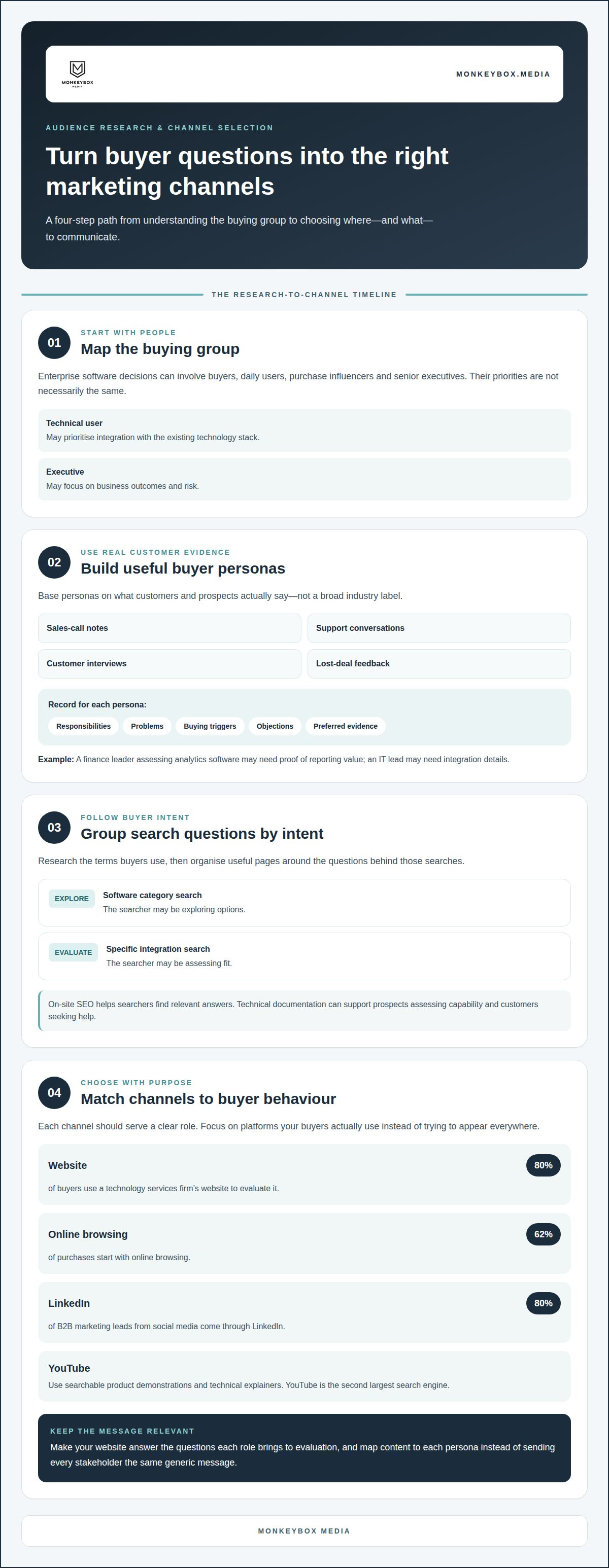
Start with the buying group, not a broad industry label. Enterprise software decisions can involve buyers, daily users, purchase influencers and senior executives, each with different concerns. A technical user may prioritise integration with an existing technology stack; an executive may focus on business outcomes and risk. 80% of buyers use a technology services firm’s website to evaluate it, while 62% of purchases start with online browsing. Make your website answer the questions each role brings to evaluation.
Build buyer personas from real customer evidence. Review sales-call notes, support conversations, customer interviews and lost-deal feedback. For each persona, record responsibilities, problems, buying triggers, objections and preferred evidence. A finance leader assessing analytics software, for example, may need proof of reporting value, while an IT lead may need integration details. Use these differences to map content and calls to action to each audience instead of sending every stakeholder the same generic message.
Keyword research should mirror those questions and the language buyers use. Group search terms by intent: a person searching for a software category may be exploring options, while someone searching for a specific integration may be evaluating fit. Use targeted phrases related to your services and expertise in useful pages, then organise those pages around clear topics. On-site SEO helps searchers find relevant answers; technical documentation can also support prospects assessing capability and existing customers seeking help.
Select channels according to audience behaviour and the task each channel performs. Treat social media as a long-term credibility investment, then focus on platforms your buyers actually use. LinkedIn is a practical channel for B2B conversations: 80% of B2B marketing leads from social media come through LinkedIn. YouTube can support searchable product demonstrations and technical explainers; it is the second largest search engine. Choose paid advertising by buyer intent and targeting needs, not a desire to appear everywhere.
To build a content marketing and SEO strategy, connect buyer questions to search topics, publish useful answers and share them through channels your audiences use. Review engagement and qualified enquiries, then refine topics and formats according to what helps buyers progress.
Map each channel to a measurable role. SEO can capture active research, social media can build familiarity, and targeted advertising can reach defined audiences. Compare performance using relevant actions, such as product-page visits, demo requests or content engagement. This gives marketing teams a clear basis for optimisation and helps leaders connect channel choices to buyer needs instead of chasing reach alone.
3. Customer value propositions and differentiation
A strong value proposition tells a specific target buyer why your software matters. Anchor it in a challenge, a distinct capability and a business outcome. For example, a data platform might help operations teams identify reporting delays and reduce manual reconciliation. That is sharper than simply claiming the product is innovative. High-growth firms are almost three times more likely than other firms to have a strong differentiator, making clear positioning a growth priority.
Build the proposition from customer evidence. Review sales conversations, support themes and product feedback, then identify the challenge buyers describe repeatedly. Connect that challenge to a capability and explain the practical result. A useful structure is: “For [audience] facing [challenge], our software helps [outcome] through [distinct capability].” Test the wording with sales and customer-facing teams. If they interpret the promise differently, refine it before using it in campaigns.
Case studies make that promise tangible. 78% of buyers look at case studies before making a purchase. Choose a customer whose problem reflects the intended audience, then show the starting challenge, the solution selected and the outcome achieved. For example, explain how a software team addressed a fragmented reporting process, which capabilities mattered and what changed in the customer’s workflow. Include enough context for readers to judge relevance, rather than presenting an isolated success claim.
Customer success stories can also help buyers compare their own needs with a real implementation. Add the customer’s industry, role and use case where they agree to be identified. Describe the decision process and lessons learned, not only the final result. A story about integration planning may speak directly to an IT buyer, while a finance leader may value evidence about reporting and decision-making. Keep claims precise and supported by the customer’s experience.
Testimonials provide a shorter form of social proof. BrightLocal found that 88% of consumers trust user reviews as much as personal recommendations. Ask customers for specific feedback about a real experience, such as onboarding, usability or a resolved operational challenge. Place relevant comments beside the product explanation they support. A quote about implementation should not be used to imply an unmentioned security benefit. Accuracy protects credibility and sets sound expectations.
Treat differentiation as the basis for consistent engagement, not a slogan to publish once. Compare your proposition with the alternatives buyers actually consider, then clarify what your product does differently and for whom. Use customer language on product pages, in sales materials and across campaigns. Track which messages generate qualified conversations and which cause confusion. If the evidence points to a mismatch, revisit the target audience, stated challenge or intended outcome. A successful value proposition helps buyers recognise fit and gives internal teams a shared way to communicate it.
4. Marketing automation and lead nurturing
Automation works best when it moves a known prospect towards a useful next step. Map the journey from first enquiry to sales conversation, then assign a relevant action to each stage. For example, a prospect who downloads an integration guide could receive a product walkthrough, followed by implementation details. A customer seeking support content should receive help, not an acquisition pitch. Clear rules keep communication consistent and relevant.
Build nurture sequences around your target audience’s questions and behaviour. A marketing-qualified lead who visits pricing information may need a comparison guide, while a technical evaluator may need architecture details. Automated email marketing can deliver relevant content at scale and at the right point in each audience’s journey. Choose the format to suit the decision: an email, technical article or recorded demonstration. Give each message one clear next action.
Integrated marketing systems make those journeys coherent. Connect campaign, website and customer relationship data so teams can understand a lead’s interactions. If a prospect attends a webinar and later views a product page, for example, that context can inform the next follow-up. Define shared fields, naming conventions and ownership before connecting systems. Inconsistent data can cause automation to send duplicate messages or treat one person as several leads.
Use lead scoring to help teams prioritise follow-up, not to replace judgement. Assign weight to actions that indicate interest, such as requesting a demonstration or returning to a product page. Review the rules with sales, then compare high-scoring leads with actual sales conversations. If casual engagement counts for more than a buying signal, adjust the model. Marketing Ops can govern these processes, data definitions and campaign hand-offs.
Automation and AI also create competitive pressure. Other software firms can use similar tools to speed up content production, audience segmentation and campaign execution. Speed alone won’t create a durable advantage. Generic AI-generated messages can weaken credibility, while inaccurate data can make personalisation feel intrusive. Set human review points for product claims, customer examples and high-impact communications. Use AI agents for defined workflow tasks, with clear inputs and review steps.
Measure the system at each stage. Track whether emails prompt meaningful actions, qualified leads receive timely follow-up, and hand-offs reach sales with useful context. Compare performance by audience, campaign and message format. If a sequence earns opens but few product evaluations, revise its offer or next step. Monitor unsubscribe patterns and sales feedback too. Marketing automation should improve visibility into the journey, reduce repetitive work and help teams learn what moves buyers forward.
5. Marketing’s strategic role and performance measurement
Marketing becomes strategic when it helps shape growth and profitability decisions, not simply deliver campaigns. High-growth technology services and software firms are 44% more likely than no-growth peers to involve marketing in implementing those strategies. That involvement connects market insight, product positioning and channel investment to commercial priorities. It also gives marketing a seat in decisions about which audiences, offers and routes to market deserve focus.
Performance measurement makes that role accountable. High-growth firms are 60% more likely than no-growth peers to task marketing with tracking metrics and linking them to campaigns. Start with a business objective, such as generating qualified opportunities, then map the customer actions that indicate progress. Website visits, conversion rates, click-through rates, return on ad spend and customer acquisition costs can show different parts of the journey.
Build a measurement framework that distinguishes activity from outcomes. A search campaign may attract relevant visitors, but visits alone don’t show whether the right buyers are converting. Review the path from search impression to landing-page action, qualified enquiry and sales opportunity. If traffic rises while qualified enquiries stay flat, examine search intent, page relevance and the next step offered. Diagnose the system, not just the headline metric.
Set ownership and definitions before reporting. Marketing and sales should agree on what counts as a qualified lead, when an opportunity begins and how campaign influence is recorded. A webinar attendee who later requests a demonstration, for example, may have had several meaningful interactions. Record those touchpoints consistently and discuss them alongside sales feedback. Attribution is more useful as a shared decision aid than as a claim that one channel caused a sale.
Use a regular review cycle to turn data into action. Compare campaign performance with the original objective, identify where buyers drop away, then choose one change to test. A landing page with strong traffic but weak conversion may need clearer messaging or a more relevant call to action. A paid campaign with high acquisition costs may need tighter targeting or a different offer. Document the decision and review the next results.
Digital marketing also needs to account for long-term contribution. SEO visibility can take sustained effort to build, while paid campaigns often generate results sooner. Track leading indicators, such as qualified visits and demo requests, alongside later outcomes, such as opportunities and customer acquisition costs. This balanced view helps leaders avoid cutting valuable activity too early or scaling campaigns based only on clicks. Make measurement part of planning, not a report assembled after launch.
When your reporting doesn’t connect campaigns to growth priorities, bring marketing performance into strategic planning and build a clearer measurement framework.
Monkeybox Media: Fractional CMO
Monkeybox Media provides Fractional CMO leadership for B2B technology companies that need stronger strategic direction and clearer marketing accountability. Turn to this support when campaign activity isn’t connected to growth priorities, or when your team needs a focused go-to-market plan for a software product.
GTM Strategy can align audience, positioning and routes to market. Marketing Automation and Marketing Ops can connect lead journeys, systems and measurement, giving teams a more structured way to manage execution. The priority is a coherent operating plan, not a collection of disconnected tactics.
If your marketing needs clearer leadership, stronger coordination or a more disciplined growth plan, contact Monkeybox Media or visit monkeybox.media.
Turn your strategy into a focused growth system
Turn your marketing strategy for technology companies into a working plan, with clear ownership, priorities and decision points. Choose one commercial objective, identify the work that supports it, and make sure each team understands how progress will be assessed. That creates a practical operating rhythm, not another strategy document left unused.
As market feedback comes in, use it to sharpen the plan. Sales conversations can reveal changing objections, customer discussions can expose new needs, and campaign data can show where the journey loses momentum. Bring those signals together before shifting resources or adding activity. Strong execution comes from deliberate adjustments and keeping teams aligned around the same growth priorities.
If you’re ready to give that work clearer leadership and direction, contact Monkeybox Media to discuss your strategy. Start the next phase with a plan your team can put into motion.
Frequently Asked Questions
How do you market software effectively?
Market software by showing the right buyer how it solves a costly or time-consuming task. A workflow platform, for example, can demonstrate how a team handles an approval process before and after adoption. Make the next step clear, such as booking a tailored demonstration or starting a guided evaluation. Equip sales teams with concise answers to common concerns about implementation, integrations and internal adoption.
How long does it take to see results with your digital marketing strategy?
Results depend on the channel, buying cycle, audience readiness and strength of the offer. Paid campaigns can surface response signals sooner, while organic search visibility builds through sustained publishing and optimisation. Separate early indicators, such as qualified enquiries, from later outcomes such as closed business. For example, assess whether a new campaign attracts the intended job roles before judging its contribution to sales.
What are the key elements of a marketing strategy for a technology company?
A marketing strategy for a technology company needs a defined growth objective, a clear market position, a route to reach buyers and an operating plan. Set ownership, budget priorities and a review process so the strategy guides daily decisions. A product launch plan, for example, should state who approves messaging, how sales receives launch materials and what evidence will prompt changes after release.
How do B2B technology companies define target markets and ideal customer profiles?
Define an ideal customer profile by identifying organisations with the problem your product solves and the conditions needed to adopt it. Assess factors such as sector, operating model, existing systems, purchasing process and urgency. Then validate the profile against won and lost opportunities. If successful deployments share a particular integration need, for instance, include it in your qualification criteria.
Which marketing channels work best for technology companies in the UK?
The strongest channel mix depends on how UK buyers research, evaluate and purchase your product. Search can capture active demand, industry events can support complex relationship-building, and email can maintain relevant communication with opted-in prospects. For a specialist platform, technical communities or partner-led activity may connect you with a precise audience. Compare channels by qualified opportunities and sales progression, not reach alone.
How can technology companies measure marketing ROI, CAC, and customer lifetime value?
Measure marketing ROI by comparing the financial return attributed to marketing with the investment required to produce it. Calculate customer acquisition cost by dividing acquisition spend by the new customers gained over the same period. Estimate customer lifetime value from customer revenue and retention using a consistent method. Keep the time period, attribution rules and included costs consistent so comparisons support decisions rather than distort them.
How much should a technology company spend on marketing as a percentage of revenue?
There’s no universal percentage of revenue to spend on marketing. Set the budget according to growth targets, current pipeline, customer acquisition costs and the investment needed across channels, then adjust it using performance data.