
Static email blasts leave too much of the journey to chance. Pardot automation experts use behaviour-driven email journeys, prospect scoring, tracking, dynamic lists and recurring tasks to make B2B marketing workflows respond to prospect activity. The aim is a more relevant path from first engagement to sales follow-up.
Longer B2B evaluations often involve several decision-makers, so a single campaign rarely covers every need or moment. You may already know that consistent communication matters; the challenge is coordinating it with the signals prospects leave behind, without creating disconnected campaigns or manual work.
This guide to Pardot automation experts explains how nurture journeys differ from static-list campaigns, how scoring and grading support qualification, and how tracking and dynamic prospect lists improve follow-up. It also covers recurring automation and the planning decisions that keep workflows aligned with marketing and sales priorities. A clear structure makes the system easier to manage and improve.
Key Takeaways
- Build nurture journeys around prospect behaviour and the longer decisions common in B2B sales, rather than relying only on static campaign lists.
- Use scoring to understand engagement and grading to assess fit with your target customer profile; together, they give sales and marketing clearer qualification signals.
- Connect lead capture and engagement tracking to the follow-up process so prospect activity can inform timely, relevant next steps.
- Use dynamic prospect lists to keep audiences aligned with changing criteria, without relying on manual list updates.
- Map recurring automation to marketing priorities, then align its workflows with your wider go-to-market strategy and operations.
Automated email campaigns and nurture journeys
Pardot automation replaces one-off sends with behaviour-driven email journeys. A prospect who downloads a guide can receive relevant follow-up, while someone who requests a demo can move towards sales contact. This supports B2B decisions involving multiple stakeholders and longer evaluation periods.
How do Pardot and Salesforce Marketing Cloud Account Engagement automation features compare? Pardot is now called Marketing Cloud Account Engagement, Salesforce’s B2B marketing automation solution. It supports lead nurturing and prospect assessment; Marketing Cloud Engagement focuses on multichannel customer engagement, often for B2C strategies.
Build each automated email programme around a defined audience, an entry condition and a next action. For example, a guide download might trigger an introductory email, followed by educational content if the prospect remains engaged. Add exit conditions for a sales hand-off or unsubscribe so the journey responds to changing behaviour.
How much do Pardot automation consultants charge in the UK? Fees depend on the project scope, integrations, data quality and work involved. Request a quote to establish the price in GBP.
A campaign calendar gives each email a purpose and prevents competing messages. Plan campaigns and space sends to keep audiences informed without overwhelming them. Map product updates, events and nurture messages to audience segments, then coordinate timing with sales activity.
Authenticate the sending domain by configuring SPF and DKIM records. These records support deliverability and help protect sender reputation. Track email engagement alongside journey progression, then review whether each message serves its intended next step.
Standardise email templates with reusable layouts, clear calls to action and accessible content. Before launch, test how they render across email clients and devices using Litmus. Check links, personalisation fields and fallback text: a broken merge field can undermine an otherwise relevant campaign.
What skills and Salesforce certifications should a Pardot automation expert have? Look for Salesforce platform knowledge, segmentation, automation logic, CRM synchronisation, reporting and email deliverability skills. Relevant Salesforce certifications can support that experience, but practical campaign examples show how these skills work together.
How can you assess and hire a Pardot automation consultant? Ask for a clear explanation of their approach to journey design, data quality, testing and sales hand-offs. Compare it with your objectives and existing Salesforce workflows, or partner with dedicated marketing automation firms such as XcellentDigital to drive lead generation.
What are the steps to audit and improve Pardot automation? Map active journeys, entry rules, email content, suppression criteria and CRM outcomes. Remove duplication, test revised paths, then monitor engagement and sales follow-up.
What are common Pardot automation mistakes and risks, including GDPR compliance? Common risks include outdated segments, conflicting sends, incorrect consent handling and poor data governance. Keep marketing data and communications aligned with GDPR requirements.
How long does a typical Pardot automation implementation or optimisation project take? Timing depends on workflow complexity, data readiness, integrations, approval steps and testing needs. A focused journey with clean data requires less coordination than a broad redesign.
What results and ROI can Pardot automation experts deliver? Measure performance against agreed objectives, such as email engagement, lead qualification or sales-cycle progress. Results depend on your starting point, audience and follow-up process.
Lead scoring and grading
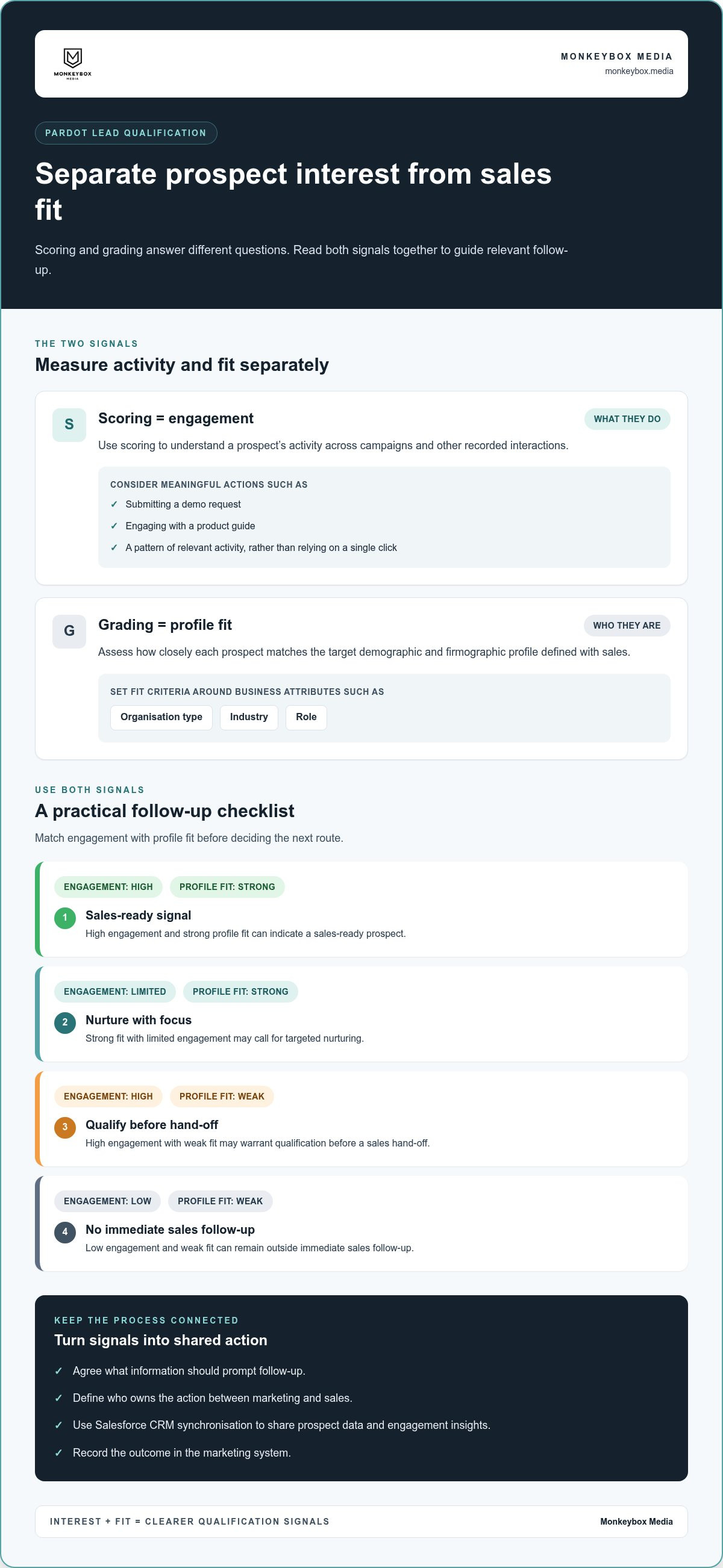
Lead scoring and lead grading answer different questions. In Pardot, scoring measures a prospect’s engagement, while grading assesses how closely they match your target demographic and firmographic profile. Someone who repeatedly views product information may show strong interest, but a contact at a small organisation outside your target market may still be a poor sales fit. Keep these signals separate.
Scoring helps marketing and sales interpret behaviour across campaigns and other recorded interactions. Set rules around meaningful actions, such as submitting a demo request or engaging with a product guide. Decide which activities indicate active research and which are weaker signals. A single click rarely tells the whole story; a pattern of relevant activity provides more context for lead management.
Grading adds a different perspective. Define your ideal prospect using business attributes such as organisation type, industry or role, then assess each prospect against those criteria. For example, an engaged contact at a target account may deserve prompt sales attention, while an equally active contact outside the target profile may need a different route. Base the criteria on how your sales team defines a viable opportunity.
Combine the signals to guide processes, not replace judgement. High engagement and strong profile fit can indicate a sales-ready prospect. Strong fit with limited engagement may call for targeted nurturing. High engagement with weak fit may warrant qualification before a sales hand-off. Low engagement and weak fit can remain outside immediate sales follow-up. These patterns give teams a shared framework for prioritising work.
Salesforce CRM synchronisation helps marketing and sales share prospect data and engagement insights. Agree on what information should prompt follow-up, who owns that action and how the outcome is recorded in the marketing system. For example, sales can note that a prospect needs more time, giving marketing a reason to continue relevant nurturing rather than treating every hand-off as a closed loop.
Review scoring and grading rules against actual outcomes. Compare the prospects routed to sales with the opportunities sales accepts, then identify which activities and profile criteria distinguish useful hand-offs. If a broad content download carries too much weight, reduce its influence; if a key product interaction is overlooked, adjust the model. Keep the logic understandable, document ownership and test changes before applying them across active processes.
Keep the logic understandable, document ownership and connect the model to measurable objectives. Align Pardot implementation plans with goals such as improving lead qualification, shortening the sales cycle or increasing email engagement. Use these objectives to review scoring and grading: the model should help teams assess whether qualification is improving, sales cycles are shortening or email engagement is increasing. This keeps adjustments tied to intended outcomes, rather than prompting changes without a clear purpose.
Lead capture and engagement tracking
Lead capture connects a prospect’s first known details with later marketing activity. In Account Engagement, a form submission can create or update a prospect record, while tracking adds context to that record. For example, someone requesting a product guide can enter a follow-up process focused on that subject. Collect information the team can use, rather than adding fields without a clear purpose.
Map each capture route to its destination and intended action. A webinar registration form might record event interest and add the prospect to a relevant follow-up journey. A demo request signals a different intent and should follow a different route. Align field names and values with Salesforce CRM so marketing and sales interpret records consistently, without having to translate inconsistent labels.
Tracking reveals what prospects engage with after capture. Email clicks, form activity and interactions with tracked pages can add useful context to a prospect’s record. For example, a contact might download a guide, return to a product page and submit another form. That sequence can inform the next communication more effectively than the original form alone.
Interpret activity in context. A single email click may reflect curiosity, forwarding or an accidental tap, rather than purchase intent. A series of relevant interactions across a campaign provides a stronger basis for timely follow-up. Review which actions indicate genuine interest, and ensure marketing and sales understand what those signals mean.
Account Engagement synchronises with Salesforce CRM, allowing teams to share prospect data and engagement insights. This makes record quality essential. If a form stores an organisation name differently from an existing Salesforce account, duplicate or incomplete records can complicate follow-up. Define field ownership, standardise key values and monitor how captured details appear in the CRM.
Tracking also supports campaign analysis. Associate capture forms and marketing assets with the campaigns they serve, then compare engagement and progression across those sources. A guide download campaign and an event campaign, for example, may attract different audiences and call for different follow-up. Consistent campaign attribution helps teams understand which activities contribute to prospect progression.
Build a review cycle around the data. Test each form submission, confirm the resulting prospect record, and check that Salesforce receives the expected fields and campaign association. Then inspect a test prospect’s activity history and verify that relevant actions appear in sequence. These checks expose broken capture routes and tracking gaps before they distort reporting or trigger unsuitable follow-up.
Useful engagement tracking connects an action to a decision: what happened, what it suggests and what should happen next. Keep capture fields purposeful, activity signals understandable and CRM records aligned. This gives marketing and sales a clearer view of prospect behaviour without treating every tracked interaction as a buying signal.
Automatically updated prospect lists
Static lists need manual updates as prospects change, creating a gap between current data and campaign audiences. Pardot dynamic lists use criteria to update membership automatically. A prospect who meets the defined conditions can enter; one who no longer matches can leave. This gives marketing automation a responsive audience instead of relying on an outdated export.
Start with the audience decision, then define the fields that represent it. For example, a campaign for a particular industry might use each prospect’s recorded industry value. A webinar follow-up list could use registration status or a related campaign field. Clear criteria matter: inconsistent values or incomplete records can prevent the right prospects from matching.
Give each dynamic list a specific purpose. A product-interest audience could include prospects whose recorded interests match that product. A newsletter audience could reflect an appropriate subscription status. A sales follow-up audience might combine a defined region with a relevant engagement condition. Keep audiences separate when their messages or next actions differ.
Design inclusion and exclusion rules together. If an event campaign targets registrants, an exclusion condition can remove people who have already completed the intended follow-up. For a nurture audience, suppression criteria can help prevent unsuitable or duplicate communications. Review how overlapping list criteria interact, especially when a prospect could qualify for several campaigns.
Dynamic lists also help teams coordinate. Marketing can use a shared audience definition to run campaigns, while sales can see which prospect group receives particular communications. Write each list’s purpose and criteria in plain language. For example, “registered for the product webinar” is more useful than an internal label that doesn’t explain the audience.
Test the criteria before activating a campaign. Check representative prospect records that should qualify and those that should not. If a prospect is missing an industry value, decide whether that record should remain outside the audience or enter another process. This review exposes data gaps and rule issues before the list drives email activity.
Keep list criteria aligned with current campaign goals. When product focus, target market or follow-up process changes, review the related rules rather than carrying old segments forward. Monitor whether the resulting audience reflects the intended prospects, and adjust the criteria when data patterns or business priorities shift.
Automatically updated prospect lists reduce manual audience upkeep, but depend on useful data and precise definitions. Treat each list as an operational rule: specify its purpose, define matching conditions, consider exclusions and test real records. This discipline makes the audience more reliable and gives campaigns a cleaner starting point.
Monitor whether the resulting audience supports the intended campaign, then adjust criteria when prospect behaviour changes. Traditional email marketing tools typically send campaigns to static lists, whereas Pardot can respond to prospect engagement with behaviour-driven automation. Marketing Cloud Account Engagement, formerly Pardot, is Salesforce’s B2B marketing automation solution for generating and nurturing leads, building prospect relationships and assessing marketing results.
Pardot is intended to support B2B sales processes that involve multiple decision-makers and longer evaluation periods by nurturing prospects over time. Store marketing data according to GDPR and CCPA requirements to help protect businesses’ and prospects’ privacy rights.
Background and recurring automation
Pardot began in 2007, founded by David Cummings and Adam Blitzer as a B2B marketing automation tool. ExactTarget acquired Pardot in 2012, then Salesforce purchased ExactTarget in 2013, bringing Pardot into its marketing ecosystem. Salesforce renamed Pardot Marketing Cloud Account Engagement in 2022. That history explains the platform’s close connection with Salesforce.
Recurring automation turns repeated marketing activity into defined processes. A team might use a recurring task to review prospect records, check campaign responses or follow up on assigned sales actions. The value comes from clarifying ownership and the next step, rather than relying on someone to remember a manual task.
Separate scheduled work from behaviour-triggered automation. A recurring review can prompt a team member to inspect records with missing details, while an automated rule can respond when a prospect meets specific criteria. A weekly data-quality review and an immediate response to a demo request, for example, serve different purposes. Keep the workflows distinct and document their owners.
Use a simple operating pattern for each recurring process: define the trigger or schedule, name the responsible role, specify the action and record the outcome. A campaign review might ask its owner to check active assets, audience rules and follow-up status. A Salesforce record review might focus on incomplete fields or unresolved sales assignments.
Build safeguards into the workflow. If a recurring task could prompt repeated contact, include a clear stop condition. For example, a follow-up process should account for a prospect who has already booked a meeting or entered a sales conversation. Review suppression rules and ownership changes so automation doesn’t continue an outdated action.
Recurring processes also need maintenance. Assign an owner to review the purpose, criteria and outcomes when a campaign or sales process changes. Check whether the task still addresses a real operational need, reaches the right team and produces the expected result in Salesforce. Retire obsolete workflows instead of letting them create noise.
A compact automation register helps teams govern this activity. Record each workflow’s purpose, trigger, owner, affected records and review point. For instance, a campaign operations register can distinguish a scheduled data review from an automated prospect response. This gives administrators and marketers a practical view of how workflows fit together.
When recurring tasks and automation rules need clearer ownership or structure, explore marketing automation workflow support to connect the processes with your operating priorities.
Monkeybox Media: Fractional CMO
Monkeybox Media helps B2B organisations connect marketing automation with the commercial priorities behind their email journeys, prospect data and recurring workflows. Its Fractional CMO leadership and GTM Strategy can bring strategic direction when marketing activity lacks clear ownership or alignment with sales. Marketing Ops and Marketing Automation support the operational structure needed to turn that direction into working processes.
Consider this next step when your team needs to align campaign priorities, automation decisions and go-to-market goals, rather than add workflows without a shared plan. The focus is a coherent operating approach built around your objectives.
To discuss how this could support your marketing priorities, contact Monkeybox Media or visit monkeybox.media.
Turn automation into a focused growth system
The next step is to decide which business priority your automation should serve. Choose a clear objective, assign ownership and connect the workflow to how your team plans and executes go-to-market activity. This gives Pardot automation experts a strategic brief, not just a request to build another sequence.
Monkeybox Media brings Fractional CMO leadership, GTM Strategy and Marketing Automation together to help B2B organisations align strategic direction with operational execution. This can be relevant when your automation roadmap needs stronger leadership, clearer priorities or closer alignment with commercial goals.
Bring your current priorities and the workflow you want to improve into the conversation. Contact Monkeybox Media to discuss automation and identify a practical next step for your marketing operation.
Focused decisions create momentum. Start with the outcome that matters most, then build towards it.
Frequently Asked Questions
What does a Pardot automation expert do?
A Pardot automation expert designs and maintains B2B marketing workflows that connect prospect activity with the right follow-up. For example, they might map how a new enquiry moves from a website form into Salesforce, reaches the correct account owner and receives an appropriate response. They also diagnose workflow issues, coordinate requirements across marketing and sales, and help teams measure whether automation supports their commercial priorities.
How much do Pardot automation consultants charge in the UK?
Fees depend on the scope, integrations, data quality and work involved. Request a quote to establish the price in GBP.