
The product itself drives acquisition, retention and expansion in a product-led growth GTM strategy. Prospects experience its value through self-service, while sales steps in when product behaviour signals a need for guidance or stronger buying intent. It’s a joined-up growth model, not a choice between product and people.
That distinction matters when deciding how customers should first experience your offer. A free trial suits products whose value becomes clear through hands-on use over a set period. Freemium can work when users get ongoing value from a free tier and have a clear reason to upgrade. A self-service demo offers another route when prospects need to see the product in action before committing.
This guide explains how product-led growth works, what makes a product suitable for self-service adoption, and how to choose between trial, freemium and demo models. It also covers how to define product-qualified leads using meaningful usage signals, prioritise them for timely sales outreach, and combine product-led and sales-led motions without slowing growth at the handoff.
Key Takeaways
- Choose a self-serve model around how quickly users can experience value and what they need to keep using the product.
- Combine product-led adoption with sales support when buyers need guidance or product behaviour shows clear buying intent.
- Prioritise product-qualified leads using repeated, meaningful product use rather than a one-off sign-in.
- Reduce friction in onboarding and shorten the path to a first useful outcome to strengthen product adoption.
- Align product signals, sales handoffs and marketing operations so each team acts on the same growth priorities.
Hybrid GTM strategies combining product-led and sales-led motions
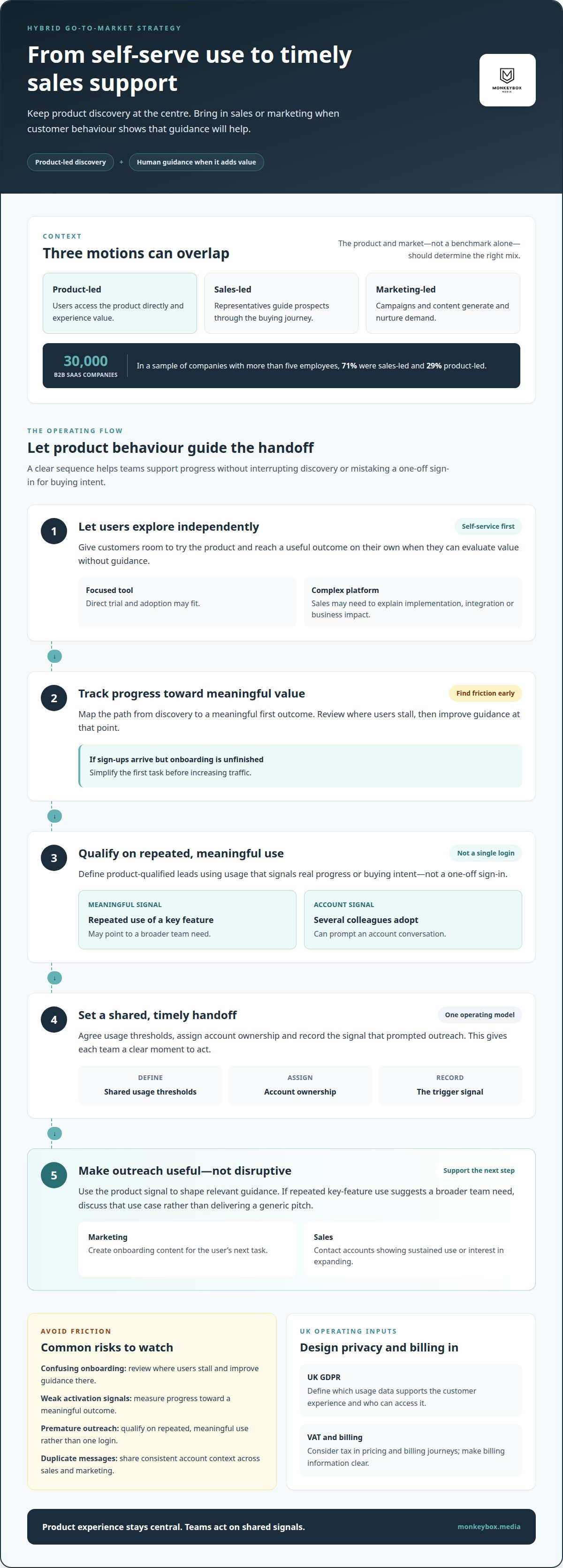
A hybrid motion lets customers explore independently, then brings sales or marketing into the journey when their involvement adds value. The right balance depends on product complexity, buying behaviour and the path to revenue.
Comparing Go-to-Market Motions
A go-to-market motion defines whether product use, sales conversations or marketing activity leads customer acquisition. Product-led growth gives users direct access to experience value; sales-led growth relies on representatives to guide prospects; marketing-led growth uses campaigns and content to generate and nurture demand. These motions can overlap. In a sample of 30,000 B2B SaaS companies with more than five employees, 71% were sales-led and 29% product-led. That comparison helps frame the decision, but the product and market should determine the mix.
Sales Cycles and Target Markets
Sales cycles reflect how buyers assess a product, while target markets shape how much guidance acquisition requires. Self-service can reduce friction when an individual user can test the product and see value independently. A complex platform, by contrast, may need sales support to explain implementation, integration or business impact. A product bought by several functions may suit a sales-led route, while a focused tool can support direct trial and adoption.
How Sales and Marketing Support Product-Led Growth
Sales and marketing support a product-led motion by connecting product behaviour with relevant guidance. Marketing can create onboarding content for a user’s next task, while sales can contact accounts showing sustained use or interest in expanding. For example, a team might trigger an account conversation when several colleagues adopt the product. A product-led growth GTM strategy works best when the product experience stays central and outreach removes friction rather than interrupting discovery.
Building a Clear Sales Handoff
A sales handoff turns meaningful product activity into a timely conversation. Define shared usage thresholds, assign account ownership and record the signal that prompted outreach. If repeated use of a key feature suggests a broader team need, for example, sales can discuss that use case instead of delivering a generic pitch. Shared handoff criteria and outreach triggers give product, marketing and sales one operating model, with a clear moment for each team to act.
Risks and Mitigation
Common risks include confusing onboarding, weak activation signals and sales outreach before users experience value. Mitigate them by tracking progress towards a meaningful product outcome, reviewing where users stall and improving guidance at that point. Set clear qualification criteria so a single login doesn’t count as buying intent. Sales and marketing should also use consistent account context to prevent duplicate messages that create friction instead of helping users progress.
UK Considerations: GDPR and VAT
UK teams should account for UK GDPR when designing product analytics and customer communications, and consider VAT in pricing and billing journeys. Treat privacy and tax requirements as design inputs, not last-minute checks: define what usage data supports the customer experience, who can access it and how billing information appears. This aligns product, marketing and sales activity with the operational requirements of serving UK customers, without letting data collection or checkout create avoidable friction.
Free trials, freemium, and demo models
Free trials, freemium access and self-service demos let prospects experience a product before speaking with sales. Choose the route that best demonstrates its value and supports the next buying decision.
Trial and Freemium Models
A free trial provides access for a set period, while freemium keeps a useful free version available. A reverse trial gives new users access to paid features first, then moves them to a free tier unless they upgrade. Each model shapes activation differently. A project tool might use a trial to demonstrate team workflows, while a simple utility may offer lasting free access.
Use a trial when users need focused access to judge a product’s value. Freemium can suit products that remain useful without advanced features, with paid capabilities offering a clear next step. A reverse trial can reveal premium value before users decide. Customer success can reinforce onboarding with timely guidance, while a demo suits products that need a guided walkthrough before self-service use.
Pricing and Packaging
Pricing and packaging connect product access to the value customers receive and the point at which they need more. A free version should solve a real, bounded task; paid tiers should make the upgrade logic clear. A team could start with individual use, for example, then pay for capabilities that support collaboration. This gives users a visible path from first value to wider adoption.
Keep the decision clear: explain what each version enables, what changes at upgrade and how billing works. Avoid placing essential activation features behind a tier users can’t access before experiencing value. A product-led growth GTM strategy depends on a direct link between product use and purchase choice, not pricing complexity that interrupts evaluation.
Acquisition and Activation Funnels
An acquisition and activation funnel tracks how prospects move from discovery to a meaningful first outcome. Map each stage by channel, such as a marketing page, referral or in-product invitation. Then identify where users drop off. If sign-ups arrive but users don’t complete onboarding, for example, simplify the first task before increasing traffic.
Define activation through a behaviour that demonstrates value, such as creating a first project or inviting a colleague. Review the steps between sign-up and that moment. Remove unnecessary fields, clarify prompts and place help beside difficult actions. Growth loops can extend acquisition: a user shares a project, a colleague joins, and that colleague experiences the product directly. Track each transition to see which loop supports sustained use.
Use funnel behaviour to refine the channel, onboarding and follow-up together. For example, a demo request may signal a need for human guidance, while repeated product use can indicate readiness for an upgrade conversation. A joined-up GTM approach can connect those signals with marketing activity and customer success, keeping each next step relevant to the user.
Identifying and prioritising product-qualified leads
A product-qualified lead (PQL) is a prospect whose product interest, usage and behaviour indicate buying intent. Prioritising PQLs means turning those signals into relevant action, rather than treating every sign-up as sales-ready.
Define Qualification Through Product Behaviour
Start with actions that show a user is reaching value, such as completing a core task, returning to a key feature or inviting colleagues. Regular active use is a stronger signal than a single login with no return. One action can be misleading: repeated use of a collaboration feature, for example, may indicate wider team potential.
Set qualification criteria around the product’s actual value path. Combine frequency, feature depth and account context, then distinguish exploratory use from sustained adoption. Teams can typically begin identifying PQLs within weeks of implementing product tracking. Use the resulting behaviour to time outreach, not to contact users three months too early.
Prioritise Signals, Not Sign-ups
Rank leads by the strength and combination of their actions. A user who returns regularly, completes a high-value workflow and invites colleagues should usually rank above someone who only creates an account. Give sales a clear summary of the signals, including the feature used, the outcome reached and the account’s recent activity. That context makes the first conversation relevant.
Activation deserves close attention: 40% of teams tracked it as their number-one metric, describing it as the instant a user becomes a PQL. Define that moment for your own product through observable behaviour. For example, a reporting platform might treat a generated and shared report as a stronger signal than simply opening the dashboard.
Use Enrichment Carefully
Clay can support lead enrichment by adding company and contact context to product activity. Use that context to assess whether an active user belongs to a target account, holds a relevant role or may connect to a broader buying group. Enrichment adds context; it doesn’t prove intent. Keep product behaviour at the heart of qualification, and use account details to shape the next action.
A user repeatedly exploring a team feature at a target company may merit a sales conversation. An individual with similar activity but no clear organisational fit may need in-product guidance instead. This distinction helps avoid routing every active user to sales, which can waste effort and disrupt product-led conversion.
Build a Useful Handoff
Connect product events, lead records and sales workflows so qualification leads to a consistent response. Record the trigger, assign an owner and tailor the next step to the user’s behaviour. A product-led growth motion works best when sales receives actionable context, while users who aren’t ready continue to get relevant onboarding and product guidance.
What is a Product-Led GTM Strategy?
A product-led go-to-market strategy makes the product itself a primary driver of acquisition, adoption, retention and expansion. Product experience shapes the funnel, while marketing and sales support the moments when people need more context.
Product-Led Go-to-Market Definition
Product-led growth is a go-to-market approach where prospects experience product value directly, rather than relying solely on sales conversations or marketing claims. This changes how teams engage buyers: access, onboarding and useful product behaviour become part of the acquisition journey.
In 2026, 58.2% of organisations were partially or fully product-led. That doesn’t mean product-led and sales-led are opposites. A product can help users evaluate independently, while sales supports complex purchasing decisions and marketing clarifies the use case. Forrester Research reports that three out of four buyers prefer to educate themselves rather than speak with a salesperson. Product access can meet that preference with evidence, not just messaging.
Product and Go-to-Market Workflows
Product and go-to-market workflows connect what users do with how teams respond. An analytics platform might guide a new user to build a first report, then show relevant help when they explore advanced features. Product teams improve the experience, marketing aligns messaging with each stage, and sales responds when account behaviour signals a broader need.
This system works when teams share definitions for activation, adoption and expansion. If marketing counts a form submission as progress but product tracks completed workflows, the funnel becomes difficult to interpret. Align event names and customer stages, then connect them to specific actions. A user who completes a core task might receive advanced guidance, while a team inviting colleagues could see collaboration-focused content.
Building a Product-Led Growth Strategy
Build the strategy by mapping a buyer’s first problem to the product action that demonstrates a solution. Identify barriers between sign-up and that outcome, then shape onboarding and product prompts to remove them. A team collaboration tool, for example, could make creating a shared workspace the first meaningful step.
Then align acquisition channels, product experience and team responsibilities. Make the marketing promise match what users can experience; define which product behaviours show progress; and decide where human support adds value. Gartner research found that 75% of B2B buyers prefer a rep-free sales experience. A product-led growth GTM strategy should therefore make self-education easy and provide a clear path to sales guidance when complexity rises.
Product-led growth strategy characteristics
Strong product-led growth combines self-service onboarding, a short path to value and product signals that guide ongoing decisions. Together, these elements help users discover value, return for it and expand their use as the product solves more of their needs.
First, the product must deliver a meaningful outcome without requiring a sales representative to explain every step. Start with research and product discovery: identify the problem users need to solve, then make the first useful action intuitive. A project management platform, for example, could guide a new user to create a workspace and organise an active project, rather than presenting every feature at once.
Time to value measures the journey from sign-up to a user’s first meaningful outcome. Assess whether users can reach that point within a target such as 7 days or 30 days, depending on the product and its use case. Shorter time to value is directly correlated with higher conversion and retention. The practical goal is to remove steps that delay value, not to force every product into the same onboarding timeline.
Successful onboarding also makes the next useful action clear. A user who completes one workflow might see a relevant feature prompt; a team that repeatedly uses a shared workflow might benefit from guidance on broader adoption. Each prompt should follow real product behaviour. Otherwise, extra messages and feature tours can add friction without helping users progress.
Product-led growth needs a feedback loop, not just a sign-up funnel. Teams can connect usage, retention and expansion signals to product improvements, onboarding changes and sales follow-up. Repeated use of a core feature alongside invitations to colleagues, for example, may show that a product is spreading across a team. That pattern can inform both the product roadmap and the timing of an upgrade path.
Assess the model through a small set of connected measures:
- Time to value: Track the time from sign-up to the first meaningful outcome, then identify steps that delay it.
- Activation: Define the product action that demonstrates a user has experienced initial value.
- Retention: Examine whether users return to complete valuable workflows, not merely whether they log in.
- Expansion: Watch for behaviours such as inviting colleagues or adopting additional features before presenting an upgrade.
Read these measures together. If sign-ups rise but users don’t reach activation, improve onboarding before adding acquisition activity. If activated users don’t return, investigate whether the product supports a recurring need. If usage spreads across teams, make the upgrade path reflect that growing value. This sequence turns product data into specific decisions, rather than isolated dashboard figures.
To align these characteristics with commercial priorities, shape a product-led GTM strategy around the product’s value path, user behaviour and expansion signals.
Monkeybox Media: GTM Strategy
Monkeybox Media helps B2B organisations connect product-led growth with a clear go-to-market plan. Turn to its GTM Strategy when you need to align product signals, sales priorities and marketing activity around a coherent growth model.
Fractional CMO leadership provides strategic direction, while Marketing Ops and Marketing Automation structure the workflows that support it. This can include connecting product-qualified lead signals to relevant follow-up, clarifying team responsibilities and making customer data useful across go-to-market activity. The focus is practical alignment: a strategy teams can apply, supported by the operations needed to run it.
If you’re ready to align your product-led approach with commercial priorities, contact Monkeybox Media to discuss your GTM needs.
Turn the strategy into your next growth decision
Choose one strategic question your teams can answer through customer behaviour. Perhaps you need to know whether self-service adoption can support expansion, or where human guidance makes a complex purchase easier. Make the decision explicit, then align product, marketing and sales around the evidence they’ll use to assess it.
A product-led growth GTM strategy becomes more durable when teams treat learning as an operating discipline, not a launch phase. Give ownership to the people who can act on customer signals, connect those signals to commercial priorities, and make adjustments part of regular planning. This creates a model that can evolve as your product, customers and market change.
For strategic support in shaping that direction, contact Monkeybox Media to discuss your GTM strategy. Take the next step with a clearer path from product value to sustainable growth.
Frequently Asked Questions
Is product-led GTM the same as product-led growth?
No. Product-led GTM describes how a company takes its product to market, while product-led growth is the broader approach that puts product value at the centre of acquisition, retention and expansion. A company might use a product-led entry point but rely on account management to expand larger customer relationships. The terms overlap, but one describes the route to market and the other the growth model.
What is product-led go-to-market (GTM)?
Product-led go-to-market uses the product experience to help prospects evaluate and adopt a solution. A prospect might create a sample dashboard, test a workflow or invite a colleague before speaking with sales. Marketing still shapes discovery, and sales can help with complex decisions. The defining feature is that direct product experience plays a central role in demonstrating value, rather than serving only as a demonstration after a sales pitch.
Evaluating what’s right for your business: PLG or SLG?
Choose based on how buyers understand value, the product’s complexity and the support needed to make a purchase. A tool with intuitive setup and an individual use case can suit self-service adoption. A platform requiring configuration across departments may need sales guidance. Map the buyer’s evaluation journey, then identify where people can assess the product independently and where expert input removes a genuine obstacle.
How do you measure the success of product-led GTM?
Measure whether the motion creates lasting customer value, not just initial interest. A product-led growth GTM strategy can compare groups of users entering through different channels, then assess adoption, retention and expansion. A cohort acquired through a webinar might sign up readily but rarely return, for example. That comparison helps teams decide whether to improve the channel promise, the product journey or the follow-up experience.
How do you turn free users into outbound leads?
Use product activity to identify a relevant reason for a sales conversation, then tailor the outreach to that behaviour. A free user who repeatedly explores shared-workspace features may benefit from a discussion about team adoption. A user who has only tried one basic task may need more product guidance. Make the message transparent, relevant and respectful of the recipient’s communication preferences.
How does product-led GTM differ from sales-led GTM?
Product-led GTM lets prospects explore value through direct product use; sales-led GTM makes salesperson-guided evaluation the primary route. With a data platform, users could inspect a sample dashboard independently, while a sales representative leads a separate conversation about integrations and organisational needs. The difference is where evaluation begins and how much guidance shapes it. The two motions can work together rather than compete.
How does product-led GTM work?
A prospect discovers a product, accesses an experience and uses it to assess a specific task. The company then responds to behaviour with relevant onboarding, education or sales support. A team member who creates a project, for example, could receive guidance on adding a colleague. If adoption spreads across the organisation, the company can offer a conversation about broader requirements and purchasing options.
What is a product-led growth go-to-market strategy?
A product-led growth GTM strategy is a coordinated plan for using product experience to attract customers and support continued growth. It connects the audience, product access, onboarding, messaging and commercial follow-up. A business targeting operations teams could align its campaign around reducing manual handovers, then ensure the product lets users experience that workflow improvement directly. The strategy links the promise to an experience customers can evaluate.