
A high lead score doesn’t automatically mean a prospect is sales-ready. The sales qualified lead (SQL) definition is a prospect the sales team has assessed as ready for direct engagement, based on evidence of fit, intent and buying readiness. An SQL is further along than a marketing-qualified lead (MQL), but it isn’t a guaranteed sale.
Looking beyond clicks helps sales determine whether there’s a genuine opportunity behind the activity. The challenge is separating buying signals from early interest, then deciding when to start a sales conversation.
This guide explains how buyer behaviour can signal readiness and how to assess budget, authority, need and timing. You’ll learn how clear qualification criteria help marketing and sales prioritise prospects, agree which leads should advance and avoid mistaking every interaction for purchase intent.
Key Takeaways
- Define qualification around fit, buying intent and readiness, then align marketing and sales on what earns a hand-off.
- Read behaviour in context: a demo or pricing request can signal stronger intent than a single content interaction.
- Use budget, authority, need and timeline to guide sales conversations, including who else is involved in the decision.
- Review lead criteria against sales outcomes so scoring supports prioritisation without screening out promising prospects too early.
What is a sales qualified lead (SQL)?
A sales-qualified lead is a prospect the sales team has assessed as ready for direct engagement. The sales qualified lead (SQL) definition rests on evidence, not a job title or a single website visit: the prospect fits the business, shows buying intent and has a plausible route to purchase. An SQL shows stronger sales readiness than an MQL, which may still need nurturing.
Qualification combines fit with intent. An ideal customer profile (ICP) describes the organisations most likely to benefit, using factors such as industry, company size, location and relevant needs. A lead from a target-sector company may fit the profile, but fit alone doesn’t prove readiness. Sales also needs signals that the organisation is considering a solution and can take part in a buying process.
Lead scoring turns agreed criteria into a consistent way to prioritise the pipeline. Explicit criteria use information a prospect provides, such as their role, organisation or stated need. Implicit criteria come from observed behaviour, including repeat visits to a pricing page, a demo request or webinar attendance. For example, one model assigns 20 points to a director-level title, 15 for webinar attendance and 10 for a pricing-page visit. Those scores are examples, not universal thresholds.
Teams can also account for poor-fit or low-intent signals. A model might subtract points when someone unsubscribes, visits a careers page or works for a rival company. Another example awards 25 points for downloading a pricing sheet and sends leads above 75 points to sales. The purpose is to represent the company’s buying criteria, not to make a score an automatic substitute for sales judgement.
How do SQL definitions vary by industry and company? Each business sets criteria around its ICP, sales process and purchase decision, so a useful threshold in one organisation may not suit another. A complex B2B offer may require evidence about several stakeholders, while another business may prioritise a direct request for pricing.
How do businesses measure SQL conversion rates and quality? They track how many SQLs become paying customers, alongside revenue attributed to those leads and movement through the pipeline. For example, 26 of 200 MQLs becoming SQLs equals a 13% MQL-to-SQL conversion rate; that figure measures progression, not eventual customer quality on its own.
What are common SQL qualification mistakes and risks? Loose criteria can pass poor-fit leads to sales, while over-qualification can exclude prospects who meet most, but not every, preferred condition. Use scores to support decisions, then review outcomes with sales and marketing to refine criteria and engage promising leads while their buying intent is active.
Lead behaviours indicating sales readiness
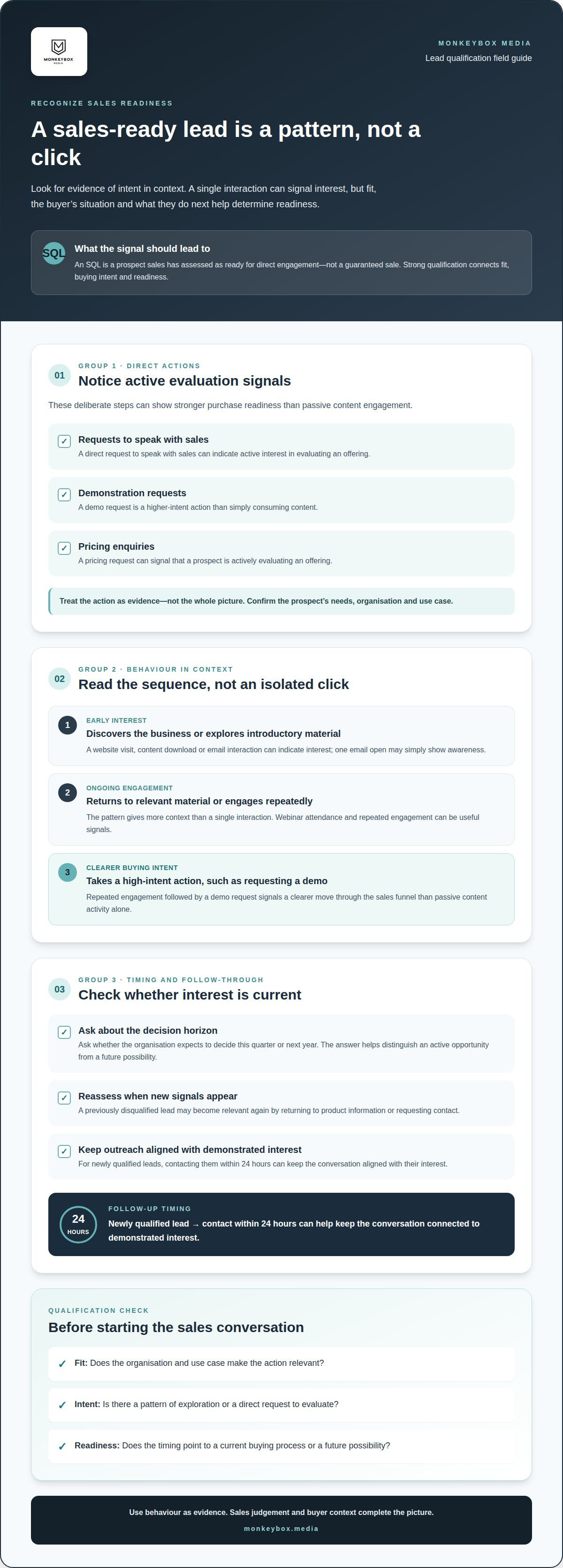
Companies assess SQL readiness by combining buyer intent with fit and direct interactions, rather than treating a single click as proof. A request to speak with sales or book a demonstration can indicate stronger purchase readiness than passive content engagement.
Purchase-Readiness Actions
Purchase-readiness actions are deliberate steps that bring a prospect closer to a buying conversation. Requests for a sales contact, demonstration or pricing show active interest in evaluating an offering. Sales can use these actions to prioritise outreach, then confirm the prospect’s needs and context. One action is evidence, not the whole picture: the organisation and use case still matter.
Buying Intent and Sales Readiness
Buying intent is evidence that a prospect is exploring a solution; sales readiness means there’s enough evidence to begin a direct conversation. Website visits, email interactions, content downloads and webinar attendance can all indicate interest, but their meaning depends on the pattern. A single email open may show awareness, while repeated engagement followed by a demo request signals a clearer move through the sales funnel.
Companies can assess behaviour as a sequence: a prospect discovers the business website, engages with relevant material, then takes a high-intent action. For example, someone who downloads an introductory guide may still be researching, while someone who asks for a sales conversation signals more immediate purchase interest. Sales should use the context gathered from these actions to make outreach relevant.
Timing and Readiness to Buy
Timing helps show whether a prospect’s interest relates to a current buying process or a future possibility. During a sales conversation, representatives can ask whether the organisation expects to decide this quarter or next year. The answer helps distinguish an active opportunity from a lead that needs continued engagement, and sets an appropriate next step for the sales funnel.
Intent can change. A previously disqualified lead may become relevant again when new behaviour shows renewed interest, such as returning to product information or requesting contact. Teams can use these fresh signals to reassess readiness instead of relying only on an earlier status. For newly qualified leads, contacting them within 24 hours can keep the conversation aligned with their demonstrated interest.
Strong qualification connects the action to the buyer’s situation: what they are trying to solve, what they have explored and what they want to do next. A company refining how these signals guide its market approach can use a GTM strategy to align engagement with the buying journey.
Budget, authority, need and timeline
Budget, authority, need and timeline give sales teams a practical framework for assessing whether interest can become a genuine buying process. Together, these BANT criteria help distinguish an active opportunity from a prospect who is still exploring.
Budget means understanding whether the organisation can fund a solution and how pricing fits its purchasing process. A prospect may have a clear need but no allocated budget, or may need approval before funds become available. Sales conversations should establish whether funding exists, who controls it and what conditions could affect the purchase decision.
Authority identifies who can approve or influence the purchase. In B2B sales, the person who first makes contact may not control the final decision. Sales teams should establish who evaluates the solution, who owns the budget and which stakeholders need to agree. A prospect who can explain the approval process gives the team a clearer route through the buying committee.
Need connects the proposed solution to an active business problem. A prospect might describe a workflow bottleneck, a growth target or a process that no longer meets operational needs. Sales representatives can explore the impact, current approach and desired outcome. This helps determine whether the offering addresses a real priority or has only attracted general interest.
Timeline reveals when the organisation expects to act and what could advance or delay its decision. A prospect planning around a renewal, project launch or internal change has a specific event shaping the purchase. Sales can then match follow-up and proposal activity to that event, rather than treating every interested lead as equally urgent.
Nurturing should reflect buying readiness, not a fixed schedule. B2B companies typically see MQLs become SQLs within 30 to 90 days, while complex enterprise sales can take more than 6 months. These periods help frame expectations, but a lead’s actions and decision process determine the appropriate next step. A prospect without current funding may need useful follow-up until budget planning advances.
Timely follow-up keeps a qualified conversation connected to the prospect’s priorities. After a discussion, sales teams can record the need, budget status, decision-makers and expected milestones, then agree on a relevant next action. For example, if finance approval is outstanding, follow-up can address the business case; if stakeholders need alignment, the next conversation can include them. This creates a clearer path from interest to revenue without rushing the prospect into a decision.
Definition of a sales qualified lead
A sales-qualified lead is a prospect the sales team has assessed as suitable for direct outreach. The classification combines evidence of fit, interest and buying readiness. For example, a company may qualify a prospect after confirming a relevant business need and a clear next step. SQL is a funnel stage, not a promise that the prospect will convert.
The distinction between an MQL, a sales-accepted lead and an SQL clarifies ownership. Marketing identifies an MQL through engagement, such as downloading a guide. Sales may accept the lead for review, then assess its needs and readiness through direct contact. Once the representative determines that outreach or a sales conversation is appropriate, the lead can be classified as an SQL.
Scoring supports the decision, but a score alone doesn’t define qualification. A model may combine company fit, role, product interest and actions such as requesting a demonstration. Sales representatives add context that tracking can’t capture, such as whether the prospect is researching for a colleague or coordinating an active purchase. Together, scoring and conversation insights make the hand-off more useful.
SQL criteria should describe observable evidence, not vague impressions. “Interested” is difficult to apply consistently; “requested a proposal after discussing a current use case” gives marketing and sales a shared signal. A documented definition also explains what happens next, such as assigning an owner, recording the need and arranging a discovery conversation. This reduces disputes about whether a lead belongs with sales.
Teams assess whether the definition works by tracking each stage and its outcomes. The SQL conversion rate measures the share of sales-qualified leads that become paying customers. The MQL-to-SQL conversion rate measures movement from marketing qualification into sales qualification. These rates answer different questions: one tests downstream sales outcomes, while the other shows how well the hand-off criteria identify sales-ready prospects.
Revenue attribution adds another layer to quality analysis. If SQLs advance to sales conversations but rarely become customers, teams can review lead fit, qualification notes and the sales process. If leads convert but generate little revenue, the organisation may need to reconsider which customer segments its criteria represent. Funnel analysis reveals these patterns, helping teams adjust scoring and qualification rules based on actual outcomes.
A strong definition is specific enough to guide action and flexible enough to recognise buying signals that don’t match every preferred criterion. Sales and marketing can review accepted, rejected and converted leads together, then refine the rules. This feedback loop keeps the SQL label connected to real purchase behaviour rather than a score that no longer reflects the business.
Sales-qualified lead definition
A sales-qualified lead is more than a record passed from marketing to sales. It’s a prospect the sales team has reviewed and judged ready for active engagement. That distinction matters: a hand-off begins qualification, while a sales conversation tests whether a genuine opportunity exists. A request for a quote, for example, signals interest but still needs context about the organisation’s intended purchase.
The operational definition should state what sales needs to know before treating a lead as qualified. It can specify the evidence required, where to record it and who owns the next action. For example, a CRM record might capture the prospect’s use case, decision process and requested follow-up. Clear fields make the definition a practical part of the sales process, rather than an abstract label.
Marketing and sales need a shared boundary between an MQL, a sales-accepted lead and an SQL. A sales-accepted lead has been passed along and accepted for follow-up; that acceptance alone doesn’t prove purchase readiness. Sales qualification comes after representatives assess the opportunity. If a lead needs more information before a useful sales conversation, the team can return it for nurturing instead of pushing it forward.
Lead scoring can support that boundary by ranking fit and engagement, but the score should prompt review rather than dictate the outcome. Imagine a high score driven by repeated visits from a company that doesn’t match the intended customer profile. A representative can investigate the mismatch before opening an opportunity. Conversely, a prospect with a lower score may deserve attention after describing a current problem and asking to discuss a solution.
Use outcomes to test whether the definition works. Sales can record why leads advance, return to marketing or stop progressing, then review those reasons with marketing. If qualified leads repeatedly lack a decision-maker, the criteria may need a clearer stakeholder signal. If strong-fit prospects are repeatedly sent back despite active buying conversations, the qualification process may be too restrictive.
This feedback loop makes an SQL definition a practical operating rule. It links marketing activity to sales action, keeps hand-offs accountable and gives teams a consistent way to interpret pipeline stages. Marketing automation can support the process by routing leads and recording engagement against agreed criteria. To connect those workflows with the qualification process, align marketing automation with lead qualification.
Monkeybox Media
Monkeybox Media helps B2B organisations connect SQL criteria with the strategy and systems behind their marketing and sales processes. If leads are reaching sales without consistent qualification, or strong prospects are getting lost between teams, its Fractional CMO and GTM Strategy offerings can help bring direction to the approach. Marketing Automation and Marketing Ops can support the processes that capture engagement, route leads and make qualification information usable across teams.
When your SQL definition is clear but the hand-off and follow-up process needs better alignment, Monkeybox Media can help. Contact the team to discuss how fractional CMO leadership and marketing operations consulting can strengthen your approach.
Make qualification part of your growth system
A useful sales qualified lead (SQL) definition should evolve with your market, not remain unchanged in a CRM. As buyer expectations, product priorities and sales processes shift, qualification criteria can drift out of step. Build a regular review into your operating rhythm: use sales feedback and pipeline outcomes to identify where definitions, hand-offs or follow-up need adjustment.
The goal isn’t to label more leads. It’s to give marketing and sales a shared decision framework that helps them act on genuine opportunities and keep future buyers engaged appropriately. When that framework is difficult to align across strategy, people and systems, experienced leadership can help establish a clearer operating model.
Contact Monkeybox Media to discuss how to strengthen your approach to lead qualification and sales readiness. A sharper process gives your team a stronger foundation for what comes next.
Frequently Asked Questions
How do MQLs and SQLs differ and work together?
An MQL is identified through marketing activity, while an SQL has been assessed by sales for direct engagement. The teams work together when marketing shares the lead’s engagement history and sales records its assessment. For example, marketing might note which webinar a prospect attended; sales can use that context to tailor follow-up and report whether the conversation revealed a live opportunity.
What comes first, MQL or SQL?
An MQL usually comes first in the qualification path, followed by sales review and possible SQL status. The hand-off isn’t automatic: sales may accept the lead for assessment, return it for further nurturing or qualify it for outreach. A lead can also show strong buying intent early, so teams should define how to handle direct enquiries that bypass the usual marketing sequence.
Are they showing real intent?
A lead’s behaviour can indicate intent, but it doesn’t prove a purchase will happen. A direct request to discuss pricing or arrange a demonstration is a stronger signal than a single email open. Sales should validate the signal by asking what prompted the enquiry and what the prospect wants to achieve. That conversation distinguishes active evaluation from research for general awareness.
How long does it take to move from MQL to SQL?
The time depends on the organisation’s buying process, the offer’s complexity and the prospect’s readiness to engage. A person researching independently may need continued nurturing, while a prospect requesting a sales conversation can be reviewed promptly. Track progression dates alongside reasons for delay, such as stakeholder alignment or budget planning. This helps teams identify process friction without assuming every lead follows the same timetable.
What about MALs and SALs?
MAL often means marketing-accepted lead, but organisations may use the label differently. Define it internally so teams know whether it describes a lead marketing has reviewed, accepted or is actively developing. SAL means sales-accepted lead: sales has agreed to follow up, but hasn’t necessarily confirmed the prospect’s readiness to buy. Clear stage definitions prevent status labels from obscuring different actions.
What are MQLs and SALs in relation to SQLs?
An MQL is a marketing-qualified prospect; an SAL is a lead sales has accepted for follow-up; an SQL has been qualified for sales engagement. The SAL can bridge marketing review and sales qualification. For example, a representative may accept an MQL, then discover that the prospect is gathering information rather than evaluating a purchase. The lead can return to nurturing until circumstances change.
What criteria qualify a lead as an SQL?
Common criteria include a relevant business need, fit with the intended customer profile, buying interest and a credible ability to purchase. Sales may also assess who influences the decision, the prospect’s intended timing and the next action they’re willing to take. A useful qualification record captures evidence, such as a stated use case or request for a proposal, rather than relying on a score alone.
How does an SQL differ from an MQL?
An MQL has shown enough marketing engagement to warrant further review; an SQL has progressed to sales assessment and is ready for direct engagement. For instance, downloading a guide may support MQL status, while discussing a specific use case with sales may support SQL status. The distinction helps teams choose an appropriate next action, rather than sending every engaged prospect straight into a sales conversation.