
A go-to-market strategy can be sound on paper and still fail in the market. The gap is often ownership: marketing, sales, product and customer teams make different assumptions, set competing priorities and measure progress in different ways. Strategic GTM leadership closes that gap by turning market choices into an accountable operating system, with clear decisions, coordinated execution and measures leaders can use to diagnose performance.
That takes more than a plan or a series of alignment meetings. It means deciding who owns the target market, positioning, route to market and cross-functional priorities, then connecting those choices to the workflows and data that guide day-to-day execution. The work is demanding, but it gives teams a shared direction and a practical way to act on it.
This article explains what strategic GTM leadership owns, how to structure decision rights and operating rhythms, and which measures help identify what’s working or blocking growth. It also explores when fractional CMO leadership can provide senior strategic ownership without a full-time appointment, linking GTM planning to marketing operations, automation and AI-enabled workflows. The goal is to move from discussing strategy to accountable execution.
Key Takeaways
- Spot whether stalled growth stems from shifting priorities, siloed decisions or unclear accountability, then address the underlying operating gap.
- Use strategic GTM leadership to clarify who recommends, decides, delivers and reviews each market priority.
- Compare internal, fractional, interim and project-based leadership by the authority, continuity and capacity your organisation needs.
- Build a repeatable rhythm for diagnosing performance, setting priorities, assigning owners and adapting execution.
- Connect B2B GTM priorities to marketing operations, automation and AI workflows so plans translate into day-to-day action.
Why Strategic GTM Leadership Matters When Growth Plans Stall
A documented go-to-market plan can define target segments, positioning and priorities, yet teams may still act as if they’re pursuing different markets. Marketing optimises lead volume, sales changes its qualification criteria, product responds to the loudest customer request, and customer-facing teams inherit expectations they didn’t help shape. The issue may not be the plan itself, but the leadership structure responsible for turning it into coordinated decisions and follow-through.
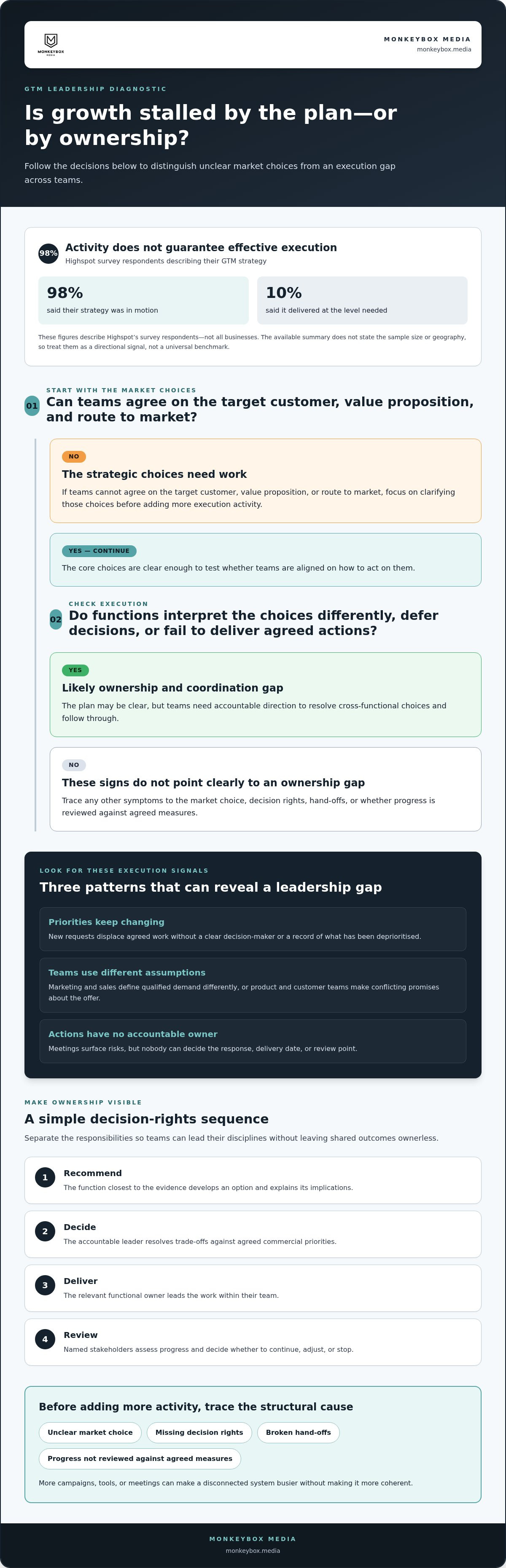
Highspot has reported that 98% of surveyed leaders said their GTM strategy was in motion, while 10% said it delivered at the level needed. These figures describe Highspot’s survey respondents, not all businesses. The available summary doesn’t state the sample size or geography, so treat them as a directional signal rather than a universal benchmark. The practical lesson is that visible activity doesn’t necessarily mean effective execution.
Strategic GTM leadership provides accountable direction across market choices and the cross-functional execution required to act on them. It connects decisions about where to compete and how to win with the people, processes and reviews that keep those decisions moving. The broader concept of strategic leadership also centres on setting direction and bringing an organisation’s capabilities to bear on its goals.
What does strategic GTM leadership mean in a B2B business?
In a B2B organisation, the role sets commercial direction, aligns functions around shared priorities and owns execution-level decisions when trade-offs arise. It’s not the same as managing campaigns or improving a single channel in isolation. A campaign manager can refine an email sequence; strategic leadership determines which audience matters, what promise the business can support and how sales, marketing, product and customer teams deliver it together.
The remit should reflect the company’s growth stage and commercial model. A business validating its first repeatable sales motion needs different decisions from one expanding into new segments or combining self-serve and sales-led routes. The key test is whether someone has the authority and accountability to resolve cross-functional choices, not simply coordinate updates.
Which signs point to a leadership gap rather than a weak plan?
Separate a strategy problem from an execution problem. If teams can’t agree on the target customer, value proposition or route to market, the strategic choices need work. If those choices are clear but functions interpret them differently, defer decisions or fail to deliver agreed actions, the gap is more likely to be ownership and coordination.
- Priorities keep changing: New requests displace agreed work without a clear decision-maker or a record of what has been deprioritised.
- Teams use different assumptions: Marketing and sales define qualified demand differently, or product and customer teams make conflicting promises about the offer.
- Actions have no accountable owner: Meetings surface risks, but nobody can decide the response, delivery date or review point.
Trace each symptom to its structural cause before adding activity. Ask whether the market choice is unclear, decision rights are missing, hand-offs are broken or progress isn’t reviewed against agreed measures. More campaigns, tools or meetings won’t fix disconnected decisions. They may make the system busier without making it more coherent. Identify the ownership gap, then assign the decision-maker, delivery owner and point at which leaders will review the outcome.
What Strategic GTM Leadership Owns Across the Revenue Engine
A clear remit connects commercial direction to the work each function controls. Strategic GTM leadership owns the choices that shape the revenue engine: which markets and customer segments to prioritise, how to position the offer, which routes to market to use, and how teams coordinate around those choices. It sets direction and resolves cross-functional trade-offs without taking over every specialist task.
Strategic GTM leadership is the accountable link between market choices and coordinated action, not a bundle of disconnected functional plans. Product, marketing, sales and customer success each bring essential expertise, but shared priorities need a consistent decision framework. Without one, each function can deliver well against a different interpretation of what matters.
Make ownership visible for every major priority. A simple decision-rights structure separates four responsibilities:
- Recommend: The function closest to the evidence develops an option and explains its implications.
- Decide: The accountable leader resolves trade-offs against agreed commercial priorities.
- Deliver: The relevant functional owner leads the work within their team.
- Review: Named stakeholders assess progress and decide whether to continue, adjust or stop.
This structure lets teams lead their disciplines without leaving shared outcomes ownerless. It also makes disagreements actionable: teams can identify whether they need stronger evidence, a decision or delivery capacity.
How does a GTM leader align functions without taking over every team?
Align functions through shared outcomes and explicit hand-offs, not by centralising every decision. Product owns product discovery and delivery; marketing owns its positioning and demand programmes; sales owns opportunity progression; customer success owns adoption and customer feedback. The GTM leader connects these contributions to common priorities and clarifies what each team must pass to the next.
Illustrative example: If the priority is to reach a defined B2B segment, product recommends which needs the offer can address, marketing recommends the message, and sales shares buying objections. The accountable leader decides the focus, functional leads deliver their work, and the group reviews agreed indicators together. Teams retain clear boundaries while working towards shared direction.
Which decisions belong at the strategic leadership level?
Leadership decisions include target-market focus, positioning, route-to-market choices, commercial priorities and resource trade-offs between competing initiatives. Execution decisions sit with the relevant specialists, such as producing campaign assets, configuring CRM fields or administering a workflow. Escalate an execution issue when it exposes a strategic conflict, such as two teams pursuing incompatible segments.
Marketing operations and automation should reinforce agreed decisions, not make them. Once leaders set the priority and hand-offs, operations can align processes and reporting, while automation can support repeatable workflows. The infrastructure serves the strategy; it doesn’t choose the market or replace accountable judgement.
For B2B organisations that need senior ownership connecting GTM choices with marketing operations, fractional CMO leadership can provide strategic direction without a full-time appointment.
Compare Strategic GTM Leadership Models Before Choosing One
The table sets out typical distinctions. Actual decision authority depends on the organisation’s agreed remit and governance.
| Model | Mandate | Continuity | Decision authority | Internal capacity | Likely use case |
|---|---|---|---|---|---|
| Internal leader | Broad, embedded commercial or GTM ownership | Ongoing | Built into the role and reporting structure | Requires a permanent internal appointment | Sustained leadership across a broad remit |
| Fractional leader | Defined senior GTM direction and execution oversight | Ongoing, with an agreed working cadence | Set through the mandate and delegated decision rights | Adds senior input alongside existing teams | Leadership needed without a full-time appointment |
| Interim leader | Temporary leadership cover or transition support | Time-limited | Agreed for the cover period | Bridges an internal leadership gap | Maintaining direction through a vacancy or transition |
| Project-based support | Bounded analysis or planning deliverables | Limited to the project | Usually focused on recommendations; implementation authority must be assigned internally | Uses internal owners to act on outputs | Producing a defined strategy or plan |
No model is automatically superior. The deciding question is whether the business needs an ongoing owner for choices and follow-through, temporary cover, or a discrete piece of work. A strategy document can clarify direction, but it doesn’t create lasting accountability unless someone in the operating system owns delivery and review.
When does fractional strategic GTM leadership fit?
A fractional model can suit a B2B organisation that needs senior direction without a permanent full-time role. The leader can connect market priorities to execution oversight, working with existing functional owners while keeping attention on agreed GTM decisions. Define the mandate first: which decisions the leader can make, which outcomes they oversee, how they work with internal leads and how often progress is reviewed. For a focused look at this model, see the fractional CMO agency guide.
When is an internal or interim leadership model more suitable?
Build a Practical Strategic GTM Leadership Operating Rhythm
A useful operating rhythm turns strategic intent into a repeatable cycle of decisions and learning. It helps leaders identify whether a priority is unclear, under-resourced, blocked by a dependency or not producing the expected result. Keep the loop visible and simple: diagnose, prioritise, assign owners, execute, review and adapt. Then run it consistently.
- Diagnose: Examine commercial outcomes, customer and team feedback, and delivery constraints. Check whether the original assumptions still hold.
- Prioritise: Choose the work most closely tied to the current growth objective. Make clear what will wait.
- Assign owners: Name the person accountable for delivery, the decision-maker for trade-offs and the teams that need to contribute.
- Execute: Make dependencies, milestones and blockers visible in a shared plan.
- Review: Compare progress with expected signals and outcomes, then identify the decision needed.
- Adapt: Continue, adjust or stop work based on what the evidence shows.
Keep the number of active priorities small enough for teams to deliver them well. If a new initiative takes precedence, state what loses capacity and why. A shared plan should show each priority’s owner, next decision, supporting teams, dependencies and review point. This makes blocked work visible before it slips and helps teams see how one delayed hand-off affects the rest of the plan.
How should GTM leaders turn priorities into accountable work?
Translate each priority into a clear outcome, an accountable owner, the decision required, contributing teams and a review point. For example, if a priority depends on product messaging before a campaign can launch, show that dependency and its owner in the plan. A task list alone isn’t accountability. Each person should understand what they own, what they need from others and how progress will be assessed.
Which review cadence helps teams learn and course-correct?
Set a recurring review suited to the pace of the work, with time to assess progress, assumptions, dependencies and decisions. Keep tactical campaign check-ins focused on delivery details; use a separate strategic review to assess commercial results and whether the direction still fits. A useful GTM review changes decisions, not just dashboards.
Separate leading indicators, which can signal whether execution is on track, from lagging outcomes that show commercial results. For example, agreed hand-off completion or campaign engagement may help explain movement, while pipeline and revenue reflect downstream outcomes. Neither category has a universal target for every business. Define measures against your model, keep CRM and marketing automation data definitions consistent, and assign someone to maintain the information leaders use. Without clear definitions and ownership, dashboards can create confidence without clarity.
A disciplined rhythm gives teams a shared way to act on evidence, resolve dependencies and adapt priorities. Explore strategic GTM support to connect planning with execution infrastructure.
How Monkeybox Media Connects GTM Strategy with Execution
A GTM plan needs more than agreement on a target market. It also needs the operating capacity to turn positioning, priorities and decisions into repeatable marketing work. Monkeybox Media connects B2B GTM planning with executive-level marketing leadership and the infrastructure that supports delivery. The focus is practical: clarify the strategic choice, align marketing activity to it, then build the processes and workflows that help teams act consistently.
This connection matters when plans sit apart from the systems used to manage campaigns, lead hand-offs and performance information. A priority to reach a particular B2B segment, for example, needs to shape the message, the activities marketing selects and the way teams manage and learn from responses. Without that link, activity can continue while drifting away from strategic intent.
How can fractional CMO leadership connect strategy and operations?
Fractional CMO leadership gives an organisation senior marketing direction without a full-time appointment. The leader can define B2B GTM priorities, align marketing plans to positioning and coordinate execution with the people responsible for delivery. Functional specialists retain ownership of their work; the leadership role keeps initiatives connected to the agreed direction and makes gaps between plans and operations visible.
That means translating strategy into operational requirements. If a business changes its priority audience, for instance, marketing operations may need to align processes and reporting with the new focus. The leader can connect those requirements, guide the work and establish how progress will be reviewed. Monkeybox Media combines strategic direction with marketing operations and implementation.
Where do marketing automation and AI agents fit?
Marketing operations can make selected workflows more structured, from campaign processes to the way information moves between activities. Automation can support repeatable steps once the underlying process and ownership are clear. It shouldn’t mask a confused hand-off or automate a decision the team hasn’t defined.
AI agents can be integrated into marketing workflows, with their role shaped around the work and operating process. They support the workflow; they don’t set market strategy or guarantee revenue outcomes. Clear purpose, accountable ownership and appropriate review keep implementation tied to business priorities rather than tool adoption for its own sake.
The next leadership decision is specific: which GTM priority needs a clear owner, stronger execution infrastructure or senior marketing direction? Answer that first, then define the mandate and the work it must move forward. To discuss how strategic GTM leadership could connect your B2B priorities with execution, discuss strategic GTM leadership with Monkeybox Media.
Make Your Next GTM Decision Count
Choose one commercial priority and test whether your organisation has the leadership, ownership and operating capacity to move it forward. Identify the decision holding back progress, who needs authority to resolve it, and what evidence will guide the next review. That gives your team a clear starting point without adding another initiative to an already crowded plan.
For B2B organisations that need experienced direction, strategic GTM leadership can connect executive-level fractional CMO support with practical marketing operations. Strategic planning can inform how automation and AI agents fit into selected workflows, with implementation tied to the work your teams need to deliver. The aim is a clearer path from market choice to coordinated action, not technology or activity for its own sake.
Monkeybox Media can help define your next leadership move and connect it to execution. Discuss strategic GTM leadership with Monkeybox Media and take the next step towards more focused, accountable growth.
Frequently Asked Questions
What is strategic GTM leadership?
Strategic GTM leadership is senior oversight that links a business’s market choices with the work required to reach and serve customers. In practice, it might help a B2B company decide whether to focus on one buyer segment, then ensure product messaging, sales conversations and customer onboarding support that choice. The role’s scope depends on the business’s commercial model and capabilities, rather than following a fixed organisation chart.
Is strategic GTM leadership the same as a fractional CMO?
No. A fractional CMO is a part-time senior marketing role; strategic GTM leadership is a broader organisational responsibility. For example, a fractional CMO might lead positioning and marketing priorities while coordinating with sales and product leaders on a shared launch. Whether that includes authority over cross-functional decisions depends on the agreed mandate. Define which decisions the role owns and which remain with other executives before work begins.
Can a small B2B company benefit from strategic GTM leadership?
Yes, if commercial decisions cross team boundaries, even when a small company has only a few people in each function. For example, one person may oversee marketing while also supporting sales, making priorities and hand-offs easy to blur. A focused leadership remit can clarify what the team will pursue, who owns each customer-facing step and what work should wait. Keep the process proportionate to the organisation’s size.
How long does it take to see the impact of strategic GTM leadership?
There’s no reliable fixed timeline; timing depends on the starting point, decision authority and pace of execution. Early signs may include fewer unresolved ownership questions or clearer hand-offs, while commercial measures can take longer to reflect changed priorities. Set observable milestones, such as agreeing a target segment or completing a planned sales enablement update, and review whether assumptions still hold. Treat milestones as evidence of progress, not guaranteed revenue results.
What should a strategic GTM leader measure?
Choose measures that help leaders make decisions, not simply populate reports. For example, if qualified opportunities aren’t progressing, compare stage conversion and sales feedback to identify whether targeting, messaging or follow-up needs attention. Pair those diagnostic signals with commercial outcomes relevant to the business. Define each measure consistently, assign responsibility for data quality and remove metrics that don’t inform a choice or prompt a useful action.
Does strategic GTM leadership replace sales or marketing leaders?
Not necessarily. Functional leaders can retain control of specialist delivery while a GTM leader coordinates decisions that span their teams. For example, marketing may own campaign execution while sales owns its follow-up process; a shared escalation route can resolve disagreement about lead definitions. Document the boundary between cross-functional authority and team management. This helps avoid duplicate direction, unnecessary approvals and confusion over who is accountable for delivery.