
The best-fit GTM consultancy isn’t necessarily the biggest name on your shortlist. Top B2B GTM consulting firms help businesses shape pricing, distribution and marketing plans, then align strategy with the execution the business needs. The right choice depends on your stage, internal capabilities and whether you need direction, hands-on delivery or both.
If growth is stalling, the issue may not be a lack of activity. It may be a disconnect between your market position, sales motion and marketing operations. Choosing a partner is therefore about more than reputation: it’s about finding the capability that closes your specific gap.
This guide compares consultancy, agency and in-house options, explains what GTM consultants actually do, and maps different types of firms to the needs of B2B businesses at different stages. You’ll also get practical criteria for evaluating fit and a decision guide to help you choose your next move.
Key Takeaways
- Match the partner model to the gap: strategic direction, coordinated delivery or sustained internal ownership.
- Choose by stage and execution capacity, not brand recognition alone; the right support changes as your growth priorities evolve.
- Assess sector experience, delivery scope and evidence of relevant results before committing to a consultancy or agency.
- For a Series A business, prioritise a focused go-to-market plan that connects customer fit, positioning and revenue execution.
- Use the decision guide to identify whether outside leadership, specialist execution or an in-house team is the strongest next move.
GTM Consultancy, Agency or In-House?
A GTM consultant helps a business develop pricing, distribution and marketing plans, then align them with revenue goals. A consultancy typically diagnoses the commercial model and sets direction; an agency focuses on delivering agreed marketing activity. An in-house team owns ongoing decisions and execution. For b2b saas startups, the best fit depends on whether the constraint is strategic clarity, specialist capacity or sustained ownership.
Large strategy consultancies compare with specialist B2B GTM firms through breadth versus focus. Bain & Company has 65 offices worldwide and works with companies in many countries, which can suit complex, multinational strategy needs. A specialist firm may offer a narrower GTM focus and closer alignment with execution; assess the proposed work, not the firm’s scale alone.
A firm’s global footprint may support international strategy, but it does not show how a particular engagement will be delivered. Define what you need: market analysis, a target-segment decision, pricing recommendations or hands-on implementation. Then compare the proposed scope with the team’s capabilities and responsibilities.
| Option | Client fit | Sector fit | Fee considerations |
|---|---|---|---|
| Strategy consultancy | Complex direction or expansion decisions | Broad, including multi-market businesses | Scope and senior expertise shape the engagement |
| Specialist GTM firm | Focused positioning and revenue challenges | Specific B2B models, including SaaS | Specialist scope and implementation depth matter |
| Agency | Defined campaign or channel delivery | Depends on channel expertise | Deliverables and ongoing management affect fees |
| In-house team | Continuous control and internal ownership | Best where internal knowledge is central | Hiring, capability and team capacity shape investment |
Fees depend on the scope, duration, seniority and level of implementation support, so request a proposal based on your requirements. Compare equivalent deliverables before weighing costs: a strategy-only engagement and an execution-led programme are not like-for-like.
Reported examples include a startup attributing 60% of pipeline contribution to a customised GTM playbook, and a SaaS firm tripling lead generation after repositioning with expert guidance. These individual cases illustrate possible outcomes, not a standard benchmark for every UK client.
For international expansion, assess demand, local buying behaviour, channel access and pricing assumptions in each target market before committing resources. Map decision-makers and external influencers, then test whether the proposed go-to-market plan accounts for those differences.
Common pitfalls include unclear ownership, broad recommendations without an execution plan, and targets disconnected from revenue. Before work begins, agree decision rights, milestones and measures. Assign internal owners who can carry recommendations into day-to-day operations.
Choose a firm whose sector knowledge and delivery scope match your immediate constraint. Compare fees only after confirming that the proposed work is equivalent.
Choosing a consulting firm by stage and execution capability
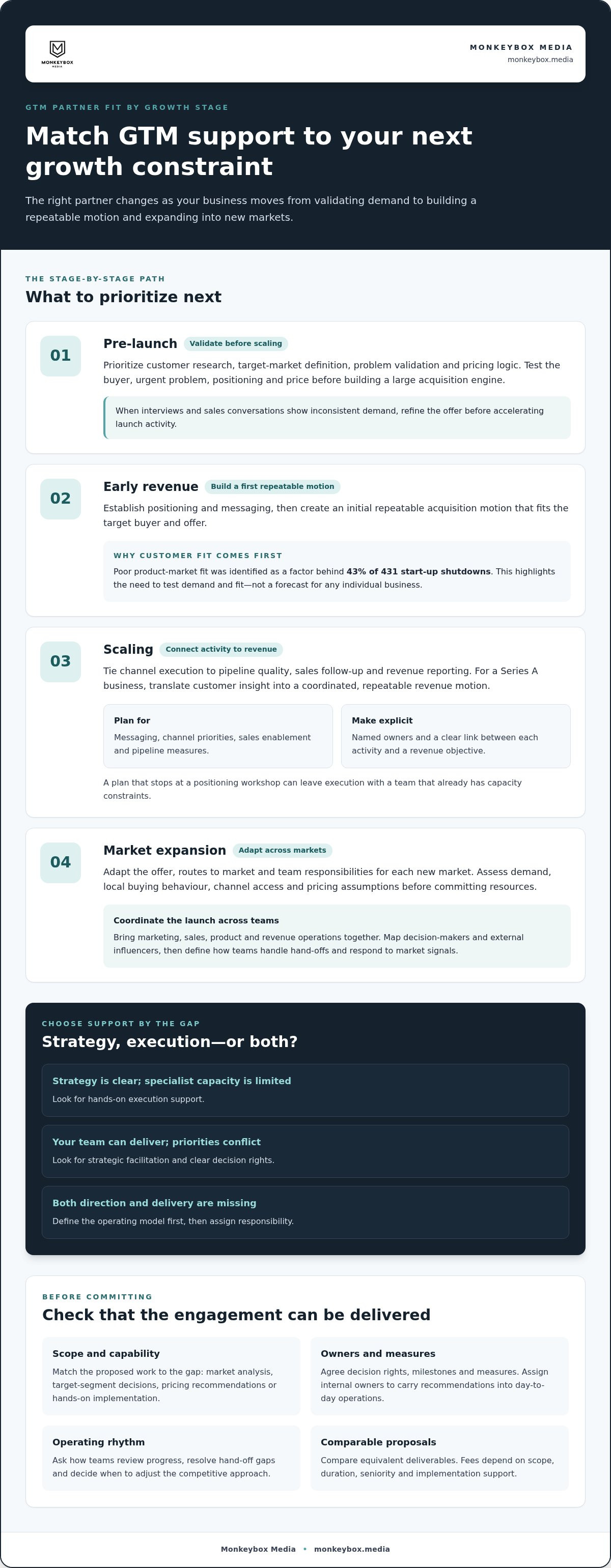
Choose a go-to-market partner based on the constraint your business needs to address next. Before launch, you may need evidence about the market, buyer and offer. A scaling business may need a repeatable pipeline motion, while a mature organisation may need to coordinate regions, product lines and revenue teams. The stage matters because one playbook cannot solve every commercial problem.
For an early-stage company, begin with customer evidence rather than channel volume. Poor product-market fit was identified as a factor behind 43% of 431 start-up shutdowns. A consultant should help test the target buyer, urgent problem, positioning and pricing before the business builds a large acquisition engine. If customer interviews and sales conversations reveal inconsistent demand, refine the offer before accelerating launch activity.
At Series A, the challenge shifts from proving demand to building a repeatable motion. Ask prospective firms to turn customer insight into messaging, channel priorities, sales enablement and pipeline measures. Deliverables should name owners and show how each activity supports a revenue objective. A plan that ends with a positioning workshop leaves execution with the same team and its existing capacity constraints.
At scale, assess whether the firm can work across functions and markets. B2B sales cycles involve multiple touchpoints, decision-makers and stakeholders, so a new segment launch needs coordination between marketing, sales, product and revenue operations. Ask for a sample operating rhythm: what teams review, how they resolve hand-off gaps, and which signals trigger a change in the competitive approach.
- Pre-launch: Prioritise customer research, target-market definition, problem validation and pricing logic.
- Early revenue: Build positioning, messaging and a first repeatable acquisition motion.
- Scaling: Connect channel execution to pipeline quality, sales follow-up and revenue reporting.
- Market expansion: Adapt the offer, routes to market and team responsibilities to each new market.
Assess capability as well as business stage. If your strategy is clear but specialist capacity is limited, choose a partner that provides hands-on execution. If your team can deliver but priorities conflict, look for strategic facilitation and clear decision rights. If both are lacking, define the operating model first, then assign responsibility for each workstream.
The risk of misalignment is material for B2B SaaS: 85% of startups struggle to achieve scalable growth because their go-to-market strategies fall out of sync. Use that finding as a prompt to test alignment, not as a forecast for your company. Map the customer promise to sales messaging, channel activity and the product experience; gaps between them expose where the next intervention belongs.
Before selecting a firm, write a one-page brief covering your business stage, target customer, current bottleneck, required outputs and internal owners. Ask each candidate to explain its first decision, the evidence behind it and how execution would work. A strong fit connects diagnosis to action while keeping your team involved.
GTM agency selection criteria
Choose an agency by the commercial problem it can solve, not its campaign portfolio alone. A programme for a B2B software launch needs clear positioning, target-account logic and sales hand-offs. A demand-generation campaign may instead focus on channel execution and qualified pipeline. Ask the agency to connect its work to your market strategy and revenue priorities.
Start with sector evidence. Review at least 3 named references in the consultant’s sector, then look for similar sales motions, buyer groups and deal complexity. A firm experienced in enterprise technology may understand lengthy approval processes, while a team focused on professional services may bring a different acquisition model. Sector fit should explain the work, not just decorate a pitch deck.
Test the proposed go-to-market strategy against your customer journey. Ask the agency to show how it moves from customer insight to messaging, channel selection, campaign design and sales follow-up. For example, if a webinar attracts target buyers but sales teams lack context, the plan should address lead handover, not just report registrations.
- Leadership: Identify the senior lead, their role and their involvement after the initial planning phase.
- Function: Confirm which work sits with the agency and which remains with your marketing, sales or product teams.
- Measurement: Connect campaign indicators to pipeline quality, conversion progress and revenue objectives.
- Execution: Set deliverables, internal owners, decision points and review rhythms before launch.
A strong proposal identifies the audience, business outcome, channels and dependencies, and makes trade-offs clear. If it recommends paid media, ask how the team will distinguish poor targeting from weak messaging or a gap in sales follow-up. This helps your team act on results instead of treating every campaign as a standalone function.
Check how the agency handles collaboration. B2B buying groups can include multiple decision-makers and external influencers, so campaign performance depends on coordinated marketing and sales action. Ask for a sample reporting view and a clear process for changing activity when evidence shifts. A fixed framework should guide decisions, not prevent adaptation.
Compare scope before proposals. Separate strategic planning from campaign production, channel management and performance reporting. Confirm who creates and approves assets, and who owns the next action when leads enter the pipeline. These details show whether the firm can deliver the operating model your team needs.
Use a clear selection process: define the business constraint, shortlist firms with relevant sector experience, review references, test the proposed framework, then document ownership and measures. This helps UK companies choose a partner whose programme fits internal capacity and commercial priorities.
GTM consulting firms for Series A B2B startups
At Series A, a B2B startup needs a repeatable route from product value to revenue. A GTM consultant can shape pricing, distribution and marketing plans, then connect them to sales execution. The strongest engagement leaves the team with a working playbook, clear owners and a way to learn from pipeline evidence. Not just a strategy deck.
Start by defining the constraint. If prospects understand the problem but reject the offer, examine positioning, packaging and pricing. If qualified prospects engage but deals stall, inspect sales messaging, buying-group coverage and follow-up. B2B buying decisions can involve many internal stakeholders and external influencers. A launch plan must equip the champion to build agreement across that group.
Ask each firm to link its proposed work to an operating outcome. A positioning engagement, for example, should define the target segment, customer problem, differentiators and proof points. A pipeline engagement should identify priority channels, campaign assumptions, qualification criteria and sales handovers. A proven method is useful only when your team can apply it to your product and buyers.
- Customer evidence: Show how interviews, win-loss patterns and sales conversations inform decisions.
- Commercial choices: Specify how target segments, pricing and distribution fit the startup’s current offer.
- Execution structure: Name workstreams, internal owners, decision points and review cadence.
- Learning loop: Explain how campaign and sales evidence will change the playbook.
Case studies can signal experience, but inspect the mechanism behind each result. One startup reported 60% pipeline contribution after adopting a customised go-to-market playbook. One SaaS firm tripled lead generation after repositioning with expert guidance. These examples show possible outcomes, not a forecast for another business. Ask what changed, how the team implemented it and which measure defined the result.
Channel choice needs the same discipline. B2B purchases involve an average of 10 channels in 2026, so a Series A company should resist spreading its team across every available route. A consultant should help prioritise channels against buyer behaviour, deal economics and internal execution capacity. Then test the focused motion before adding complexity.
Set engagement boundaries before work begins. Decide whether the consultant will advise founders, work directly with marketing and sales, or support campaign execution. Record which decisions stay with leadership and how progress will be reviewed. This helps prevent recommendations from going unimplemented because no one has taken ownership in the weekly operating rhythm.
For a Series A selection process, ask each firm to give a short diagnosis based on your market, customer evidence and current pipeline. Compare its assumptions, priorities and first practical deliverable. Choose a partner whose approach builds capability within your startup rather than relying on a borrowed playbook.
What are the top B2B go-to-market consulting firms in the UK?
There isn’t one best-fit firm for every UK business. A global strategy consultancy, a specialist GTM firm and an execution-focused agency solve different problems. A shortlist of the top B2B GTM consulting firms should reflect your sector, company stage, target market and required delivery. Compare the work each firm will own, rather than ranking names by reputation alone.
For complex expansion decisions, a large strategy consultancy may suit organisations needing broad analysis across markets or business units. Bain & Company and Deloitte represent this broader model. A specialist B2B firm may be a closer fit when the brief centres on positioning, pricing, sales motion or pipeline design. An agency is more relevant when strategy is clear and campaign execution is the primary gap.
Use these firm types to structure your shortlist:
- Global strategy consultancies: Consider for broad commercial questions, complex operating models or multi-market planning.
- Specialist B2B GTM consultancies: Compare for focused work on customer segments, positioning and revenue strategy.
- SaaS growth firms: Assess when product-led routes, subscription economics or sales-assisted growth shape the brief.
- Demand-generation agencies: Look for a clear connection between campaign delivery, lead quality and sales follow-up.
- Fractional leadership providers: Consider when the business needs senior direction without building a full internal leadership structure.
Sector fit should be demonstrated through relevant work, not broad claims. An enterprise software company needs a partner who understands complex buying groups and sales hand-offs. A specialist serving smaller B2B clients may focus instead on a shorter sales motion and leaner channel mix. Request at least 3 named references in your sector, then compare those engagements with your own brief.
Distinguish strategy from execution. A proposal may cover customer research and market positioning but leave campaigns, systems and team coordination to your staff. Another may combine planning with delivery. Gartner’s survey of 412 leaders found marketing and sales worked together in 3 of 15 commercial activities in 2024. Use that finding to assess ownership and cross-functional coordination.
For each shortlisted firm, compare sector experience, target client profile, named deliverables, internal responsibilities and evidence of outcomes. Check whether case studies explain the intervention and measure, rather than presenting a result without context. The top B2B GTM consulting firms should make their approach and scope clear enough for you to assess relevance, not promise a repeatable result.
Choose the firm whose scope matches your central constraint and internal capacity. If the priority is a coherent market approach, explore B2B GTM strategy planning as a next step.
Monkeybox Media: Fractional CMO
Monkeybox Media provides fractional CMO leadership and strategic go-to-market planning for B2B organisations that need senior direction connected to execution. Turn to this model when your team needs clearer priorities, stronger alignment between marketing and revenue activity, or a structured plan for entering or expanding within a market.
Monkeybox Media’s GTM Strategy work can set direction, while its Marketing Ops and Marketing Automation services help organise the systems and workflows that support the plan. AI agents can also be integrated into marketing workflows to improve efficiency and support scalable growth. The right starting point depends on your gap: leadership, strategy, operations or automation.
If your next stage of growth calls for coordinated marketing leadership and practical GTM planning, contact Monkeybox Media to discuss your requirements.
Turn your GTM priorities into the next move
Turn your growth ambition into a decision your team can act on. Identify the constraint holding back progress, name the person responsible for addressing it, and define the evidence that will show whether the approach is working. This gives an engagement a clear starting point and keeps activity tied to commercial priorities.
The top B2B GTM consulting firms can help shape direction, but lasting progress depends on how well strategy connects to your team’s operating rhythm. Monkeybox Media supports that connection through Fractional CMO leadership, GTM Strategy and Marketing Automation. If your priorities are clear but execution needs stronger coordination, or the strategy itself needs sharper definition, start a conversation about the work ahead.
Contact Monkeybox Media to discuss your GTM priorities. Build the next stage with focus, ownership and a clear path forward.
Frequently Asked Questions
What does a go-to-market consultant actually do?
A go-to-market consultant turns a commercial challenge into a plan for reaching and converting customers. If a software firm wins product demos but struggles to move opportunities forward, for example, a consultant can examine buyer messaging, sales stages and follow-up materials. The work may lead to a sharper target segment, a revised customer proposition or clearer sales tools. Scope depends on the problem the business needs to solve.
How do you choose the right GTM consultant?
Choose a consultant whose experience matches your business model and the decision you need to make. Give each candidate the same short brief, such as entering a new segment or improving conversion from a specific channel. Compare their diagnosis, assumptions and first proposed deliverable. Assess how they will work with your team, too: speaking with customer-facing staff can reveal practical issues that leadership discussions alone may miss.
Which UK B2B GTM consultancies specialise in SaaS and technology companies?
Specialist agencies and boutique firms often focus on technology or B2B client work. Organizations like Monkeybox Media, Foundation Marketing and Ironpaper are examples of firms associated with technology sector growth. These providers list various prominent tech and SaaS brands among their standout clients, showing relevant industry experience. However, past client lists do not establish that every firm suits every UK SaaS business. Compare the specific project team’s experience with your product, sales model and target buyers.
How do leading B2B GTM consulting firms compare by services and industry expertise?
Firms differ in breadth, sector focus and delivery. Bain & Company and Deloitte represent large consultancies suited to broad strategic questions; specialist firms may focus more tightly on B2B growth or marketing execution. Client examples can help distinguish their experience: Ironpaper lists Goddard Technologies, Steelcase and LexisNexis, while Alcimed lists Sanofi, Airbus, BASF and Roche. Treat these as clues for further comparison, not a ranking.
What GTM consulting services do firms offer, such as positioning, pricing, sales strategy and demand generation?
Common areas of work include customer research, positioning, pricing, channel planning, sales strategy and demand generation. Some engagements set direction; others also support campaign delivery, marketing operations or sales enablement. A company preparing a new offer, for example, may need pricing and positioning decisions before launching campaigns. Define the outcome first, then confirm that the proposed scope covers the decisions and practical work required.
How can businesses assess and choose a B2B GTM consulting firm?
Use a consistent evaluation process: give each firm the same business context, ask for its diagnosis, then compare proposed outputs and working methods. Request a sample deliverable, such as a segment-prioritisation framework or launch plan, to see how recommendations translate into decisions. Finally, agree how your team will review progress and resolve blockers. This shows whether the engagement fits your decision-making style and operating capacity.