
More marketing activity won’t fix a leadership gap. If campaigns keep launching without a clear link to business priorities, the issue may not be execution capacity. It may be strategic ownership. So, what does a fractional CMO do, and what changes when your business brings one into its leadership team?
The title can cause confusion. Some businesses use it to describe senior advice; others expect hands-on marketing support. The distinction that matters is responsibility: a fractional CMO owns growth direction, connecting business goals to marketing decisions, execution and measurement. They don’t simply add another pair of hands to the task list.
This guide explains the decisions and responsibilities a fractional CMO typically leads, how the role differs from consulting or tactical support, and how strategic direction becomes a practical B2B go-to-market plan. You’ll also see how marketing operations, automation and AI can support execution without replacing executive judgement, and how to assess whether fractional leadership fits the gap your business needs to close.
Key Takeaways
- Understand what does a fractional CMO do in practice, from assessing the marketing position to setting priorities and reviewing progress.
- See how executive accountability differs from personally producing every campaign, asset or channel activity.
- Compare a fractional CMO with a freelancer or consultant by looking at decision ownership, delivery focus and the purpose of the engagement.
- Assess whether fractional leadership fits by identifying the gap, clarifying priorities, defining decision rights and choosing review measures.
- Explore how B2B go-to-market strategy can connect with marketing operations, automation and AI-supported workflows.
What does a fractional CMO do, and what does the role own?
A fractional CMO is a part-time executive who leads marketing direction and connects it to the business’s commercial priorities. They help decide where marketing should focus, how the plan should be resourced, and how progress will be assessed. The role carries executive responsibility for direction and oversight, but it doesn’t mean personally producing every campaign, asset or channel task.
A fractional CMO owns marketing leadership; a freelancer owns defined delivery tasks. That distinction matters when a B2B company has plenty of activity but no clear logic linking its positioning, target market, sales priorities and investment. The CMO sets the direction and aligns the people responsible for carrying it out. Those people may be in-house employees or external delivery partners, such as outsourced marketing and branding specialists like Marketing Angels.
Which decisions sit within a fractional CMO’s remit?
The remit centres on decisions that shape the marketing system, rather than every choice made within an individual channel. Depending on the agreed scope, a fractional CMO may lead decisions about:
- Strategic priorities: which business objectives marketing should support and what to prioritise now.
- Positioning: how the company communicates its value and differentiates its offer.
- Target markets: which audiences or segments the business should focus on, informed by its goals and sales context.
- Marketing investment: how people, budgets and activity should be allocated against agreed priorities.
- Planning and review: what the marketing plan includes, which measures indicate progress, and when direction needs to change.
These decisions need to connect with sales and wider business priorities. For example, if sales teams are pursuing a particular market segment, the CMO can align positioning, demand activity and performance measures around that focus. Marketing leadership contributes to commercial performance, but it doesn’t mean the CMO has sole ownership of company revenue. Results also depend on factors such as the offer, sales execution and wider market conditions.
The Fractional Executive model describes senior expertise contributed on a part-time basis. In practice, the role’s authority and responsibilities should be clear: which decisions the CMO leads, who approves investment, and how teams report progress.
What does fractional mean in practice?
“Fractional” describes the engagement model: the executive contributes part-time rather than joining as a full-time employee. It doesn’t mean the strategic standard is reduced. The CMO is expected to bring senior judgement, set direction and lead within the responsibilities agreed with the business.
There’s no universal weekly schedule or fixed list of duties. A company clarifying its positioning may need a different rhythm from one coordinating established teams and reviewing ongoing performance. Scope and cadence should reflect the organisation’s stage, current needs and decision-making structure. Define the outcomes, responsibilities and review points up front, then adjust the arrangement as priorities change. The value lies in focused executive ownership, not simply counting hours.
What does a fractional CMO do day to day in a B2B business?
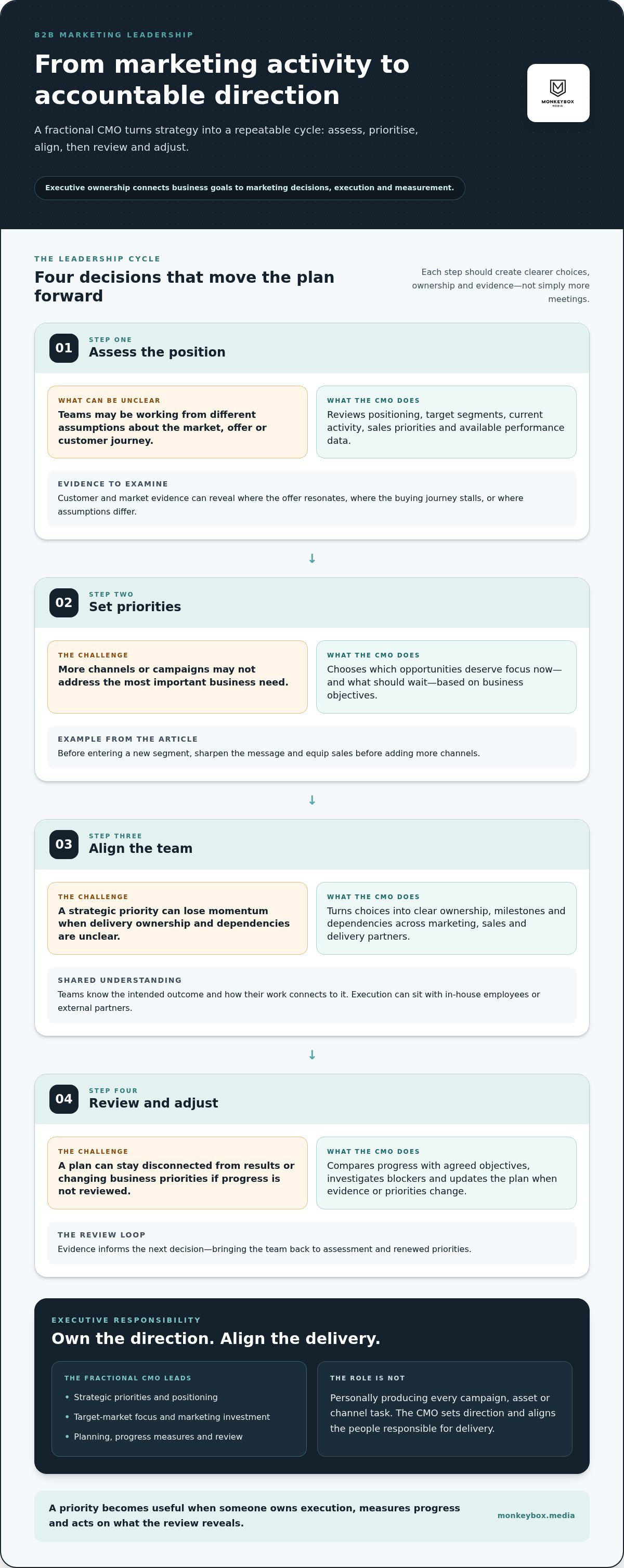
In practice, the answer to what does a fractional CMO do is less about a fixed daily task list and more about a repeatable leadership cycle. The CMO builds a clear view of the current position, identifies the most important priorities, aligns the people responsible for delivery, then reviews evidence and adjusts the plan. The rhythm depends on the business, but the work should produce decisions and direction, not just more meetings.
- Assess the position. Review the company’s positioning, target segments, current marketing activity, sales priorities and available performance data. Customer and market evidence can help reveal where the offer resonates, where the buying journey stalls, or where teams are working from different assumptions.
- Set priorities. Decide which opportunities deserve focus and what should wait. A B2B company preparing to enter a new segment, for example, may need to sharpen its message and equip sales before adding more channels.
- Align the team. Translate choices into clear ownership, milestones and dependencies. Make sure marketing, sales and delivery partners understand the intended outcome and how their work connects to it.
- Review and adjust. Compare progress with agreed objectives, investigate blockers and update the plan when evidence or business priorities change.
A clear marketing priority becomes useful when someone owns its execution, measures progress and acts on what the review reveals. This connects executive direction to operating work without making the CMO responsible for personally writing every campaign or managing every channel task.
How does a fractional CMO turn strategy into a GTM plan?
A go-to-market plan turns strategic choices into coordinated action. Positioning shapes the message; target segments define who the business is trying to reach; and commercial priorities help determine which activity gets resources first. The CMO can translate those choices into owned priorities, milestones and cross-team coordination, creating a practical B2B go-to-market strategy rather than a disconnected set of campaigns. Teams or delivery partners may handle channel execution, while the CMO maintains alignment and resolves trade-offs.
How do they lead teams and measure marketing performance?
Leadership means creating shared context across marketing, sales, internal specialists and relevant delivery partners. The CMO clarifies responsibilities, surfaces dependencies and gives teams a route to raise decisions that could slow execution. For example, sales feedback about buyer objections can inform marketing’s messaging work. The CMO can then help agree who will update the relevant materials and when.
Measures should reflect the agreed objective, not reward activity simply because it can be counted. If the priority is improving engagement in a target segment, review relevant evidence against that aim instead of relying on a broad tally of tasks completed. Reviews should answer practical questions: what moved, what didn’t, what’s blocking progress, and what needs to change? That discipline keeps the plan responsive without resetting direction every time a new idea appears.
For B2B teams looking to connect executive direction with practical GTM work, Monkeybox Media’s marketing leadership and go-to-market support brings those priorities into focus.
Fractional CMO vs freelancer or consultant: where does ownership sit?
The title alone doesn’t tell you who owns the work. A fractional CMO leads marketing priorities and maintains alignment across the business. A freelancer commonly delivers defined specialist work, while a consultant may assess a challenge and recommend a course of action. These are useful distinctions, not rigid rules: individuals shape their roles differently, so the agreed responsibilities matter more than the label.
| Role | Primary responsibility | Decision ownership | Delivery focus | Typical engagement purpose |
|---|---|---|---|---|
| Fractional CMO | Strategic marketing leadership | Leads agreed marketing priorities and helps align decisions across teams | Oversees direction, planning and performance review; delivery may sit with others | Provide ongoing executive ownership without a full-time role |
| Marketing freelancer | Specialist execution | Usually works within the brief and decisions set for the assignment | Delivers agreed work, such as a defined marketing task or asset | Add focused delivery capacity or expertise |
| Consultant | Advice and recommendations | Typically informs decisions; the client retains responsibility unless the scope says otherwise | May analyse a challenge, advise on options or support a defined project | Bring an external perspective or specialist guidance |
The distinction isn’t that one role matters more. It’s where responsibility sits. A fractional CMO shouldn’t be treated as a higher-priced label for task delivery. The value of the leadership role lies in setting priorities, making trade-offs within the agreed remit, coordinating contributors and reviewing whether the plan still fits the business.
How is a fractional CMO different from a marketing freelancer?
A freelancer may be commissioned to deliver a specific item, such as campaign copy or a defined channel task. A fractional CMO helps determine which work deserves attention, how it connects to business priorities, and how the team will assess progress. The roles can complement each other: leadership establishes the brief and direction, while specialist freelancers bring focused execution. The exact boundary depends on the people and scope involved.
How is fractional leadership different from consulting?
A consultant may provide analysis and recommendations, then leave implementation decisions with the client. A fractional CMO’s remit can extend into ongoing leadership: aligning teams, guiding priorities and reviewing progress as the plan moves forward. Part-time presence doesn’t automatically mean unclear accountability. Agree who makes which decisions, what the executive owns, and how often the work is reviewed. That clarity turns a title into a workable operating relationship.
When does fractional CMO leadership fit, and how should you assess it?
Fractional CMO leadership fits when the business needs senior marketing ownership, but the central issue isn’t simply a shortage of hands to deliver campaigns. B2B signals may include unclear positioning, disconnected marketing and sales activity, priorities that keep shifting, or no one accountable for setting marketing direction. None proves on its own that a fractional CMO is the answer. The question is whether a leadership gap is holding back coherent decisions and execution.
What business signals suggest a leadership gap?
Look for recurring patterns, not one-off frustrations. If teams can’t explain which audience matters most, marketing activity is disconnected from sales priorities, or no one can resolve competing requests, the gap may be strategic. By contrast, a clear plan with a temporary need for campaign production or specialist channel delivery may call for execution capacity instead. Diagnose the underlying problem before choosing the support model.
Use this assessment sequence to test the need:
- Identify the leadership gap. Name the decisions or coordination problems that aren’t being owned today.
- Clarify priorities. Agree what the business needs marketing to focus on and what should take lower priority.
- Define decision rights. Establish which decisions the fractional CMO can lead, where executive approval sits, and how marketing and sales leaders contribute.
- Set review measures. Choose indicators that relate to the agreed priorities, then decide how leaders will review progress and respond to what they learn.
What should the engagement make clear from the start?
Set the operating conditions before work begins: the scope of responsibility, access to relevant leaders and teams, decision-making authority, collaboration expectations and communication cadence. Agree which measures will indicate progress and when they’ll be reviewed. Just as crucially, map the execution capacity available, whether that’s internal staff, delivery partners or existing systems. A strategy can’t move into practice without clear ownership and resources to carry it forward.
A useful scope makes accountability visible. It should distinguish leadership decisions from delivery tasks, identify who will act on agreed priorities, and give the CMO a route to surface blockers. If priorities change, leaders need a shared way to decide what gets paused or reprioritised. That prevents the engagement becoming an open-ended request queue.
If your B2B business is weighing up whether the gap is strategic or operational, discuss fractional CMO leadership with Monkeybox Media to clarify the priorities, authority and execution capacity the work needs.
How Monkeybox Media connects fractional CMO leadership to B2B execution
Good marketing leadership connects direction with the systems that make execution possible. Monkeybox Media brings fractional CMO leadership and B2B go-to-market strategy together with marketing operations, marketing automation and AI agent implementation. The sequence matters: first establish what the business is trying to achieve, then shape the workflows and tools around those priorities. Technology should support the plan, not set it.
That connection turns a strategic choice into practical operating decisions. If the priority is to reach a defined B2B segment, for example, teams need an aligned message, clear responsibilities, suitable workflows and a way to review relevant performance evidence. Marketing operations can help structure those processes, while measurement helps leadership see where execution is progressing or needs attention. The setup should reflect the organisation and its agreed priorities.
- Direction: Establish the marketing priorities and how they connect to business goals.
- Planning: Translate priorities into a practical go-to-market plan with accountable owners.
- Operations: Align workflows, measurement and marketing technology to support that plan.
- Review: Use agreed evidence to identify blockers, learn and adjust execution.
How does strategic leadership connect to marketing operations?
Marketing operations gives agreed strategy a working structure. Priorities inform how teams coordinate, which processes need support, what information leaders review and which technology decisions make sense. Without that connection, new systems can add activity without solving the underlying problem. Monkeybox Media links senior marketing direction with operational planning, so workflows and measurement serve the strategy rather than becoming ends in themselves. A fractional CMO agency guide can also help frame the broader engagement model.
For instance, if a business needs more consistent coordination between marketing and sales, leadership can clarify the shared priority before operational changes are made. The teams can then identify where information or hand-offs need attention and what measures will help them review the process. The point isn’t to add complexity. It’s to make the operating system fit the work the business has chosen to prioritise.
Where can automation and AI agents support the work?
Marketing automation and AI agents can support suitable workflows once the purpose and guardrails are clear. They may help teams handle defined processes within marketing operations, while people remain responsible for strategic choices, business context and oversight. Their role is to support execution, not replace executive judgement. Clear ownership also matters: teams need to understand where an automated workflow fits and who reviews whether it still serves the priority.
That’s the distinction behind the question, what does a fractional CMO do: leadership sets direction and maintains accountability, while operational systems and tools help teams carry the work forward. Monkeybox Media connects B2B marketing leadership with GTM strategy and the operational capabilities that support execution, without treating automation as a substitute for strategy.
If your marketing direction and day-to-day execution aren’t connecting, start a conversation with Monkeybox Media about the leadership and operating challenges your B2B team needs to address.
Make your next marketing decision count
The next step isn’t to add another layer of activity. Identify the business decision marketing needs to support next, then ask whether your team has the leadership and execution capacity to move it forward. That practical test turns “what does a fractional CMO do” into a more useful question: what needs to change for marketing to contribute with focus?
Bring that challenge into a conversation with Monkeybox Media. You can explore where strategic leadership, go-to-market direction or operational support could help your B2B business move with greater clarity. Start with the decision in front of you, not a pre-set list of tasks.
Discuss your B2B marketing leadership needs with Monkeybox Media and take a clear next step towards more deliberate marketing execution.
Frequently Asked Questions
What does a fractional CMO do each week?
There’s no universal weekly schedule; the work follows the business’s agreed priorities. A week might include a leadership discussion about a launch decision, a review of campaign or pipeline evidence, a sales alignment conversation, and time to resolve a strategic blocker. The work changes as needs change. Judge the contribution by decisions advanced and agreed work reviewed, not by how many hours are filled.
Is a fractional CMO an employee or an external consultant?
A fractional CMO usually provides senior marketing leadership part-time rather than joining as a full-time employee, though the contractual arrangement can vary. The role can also go beyond advice: within an agreed remit, the CMO may lead priorities and ongoing decisions. For clarity, establish whether they’re embedded in leadership discussions, which decisions they can make, and what information or team access they need to lead effectively.
Can a fractional CMO manage an existing marketing team?
Yes, team leadership can be part of the remit if the organisation agrees to it and provides the necessary authority. For example, a CMO might help a team resolve competing requests by setting a shared order of work and clarifying who owns each next step. Before starting, map reporting relationships and decision rights. Also identify who has capacity to deliver the work, so leadership doesn’t become a substitute for missing execution resource.
How long should a business work with a fractional CMO?
There’s no single engagement length that suits every business. A company preparing for a defined launch may need support structured around that initiative, while another may need continuing oversight as priorities evolve. Set review points against the agreed objectives and use them to decide whether the scope should continue, change or conclude. Avoid selecting a term just because it sounds standard; let the leadership gap and work required guide the decision.
What should a fractional CMO deliver?
Deliverables depend on scope, but can include strategic direction, a prioritised plan, go-to-market guidance and regular performance reviews. Make the outputs tangible: for example, agree whether the engagement includes a written decision record, a plan with named owners, or recommendations for leadership to approve. A document alone isn’t the whole contribution. The value also comes from guiding decisions as implementation unfolds and adapting direction in response to what the business learns.
Does a fractional CMO execute campaigns as well as set strategy?
They can guide campaign implementation, coordinate contributors and review whether activity fits the strategy, but hands-on production depends on the agreed scope. For a product launch, for instance, the CMO might set the audience, message and success measures while an internal team or delivery partner produces campaign assets. Define who briefs, creates, approves and evaluates each element. That prevents strategic oversight and specialist delivery from becoming blurred responsibilities.
When is a fractional CMO not the right solution?
The model may not fit if the need is only for a clearly defined execution task, such as producing a specific campaign asset, with no wider leadership gap. It may also struggle to make an impact if leaders can’t make decisions or the business has no capacity to act on agreed priorities. First identify whether the main constraint is direction, delivery resource or both, then match the support to that need.